

Affiliate disclosure: This post contains affiliate links. If you buy through them, I may earn a small commission — at no extra cost to you. I only recommend products I'd point a friend to, and my editorial opinions are my own. Full disclosure here.
I'm a former cosmetic chemist, which means I spent a career on the boundary between water-loving and water-hating materials — hydrophilic absorbent fibers, hydrophobic laminates, how a textile behaves when you push it underwater. So when period swimwear started getting marketed as "waterproof, nothing seeps through," my reaction wasn't relief. It was: that is not how this fabric works, and telling people it is will burn their trust the first time they climb out of a pool.
This guide answers the question every nervous first-timer and every swim-meet teen actually wants answered: how does period swimwear work underwater, is it truly waterproof, and will blood-tinted water run down my legs when I stand up? I'll explain the real mechanism from materials principles — including the dreaded "pink puddle" — and I'll be honest in both directions: it works better than the fear suggests, and worse than the marketing claims. This is a science explainer, not a product roundup. For the full ranked brand-by-brand comparison, head to our complete period swimwear buying guide.
One boundary up front: my lane is textiles and skin science, not medicine. Anything about heavy bleeding, postpartum, PCOS, endometriosis, or whether swimming on your period is "safe" I defer to the CDC, ACOG, the FDA, or your own doctor — cited, not improvised.
Key Takeaways
- It absorbs blood; it does not keep water out. The gusset is a hydrophilic absorbent panel held against you by compression — not a sealed waterproof bag. Pool water flows freely in and out. See why.
- Your flow is physically smaller underwater, so the gusset's actual blood load while you're submerged is modest — which is the real reason a snug suit works. The reassuring counter-truth.
- The "pink puddle" is gravity, not a leak. It's diluted, blood-tinted pool water being wrung out of a saturated panel as you stand up. The physics, explained.
- No swim suit replaces a tampon or cup for medium-plus flow. Match the absorbency tier to your real flow, or double up. The buying rules.
- "Waterproof = leakproof" is a myth — one our own older guide repeated, and one I'm correcting here. Plus the truth about PFAS and the Thinx settlement.
How I evaluated these
To be upfront: I did not run lab tests. I didn't measure drip rates, time hydrostatic saturation, or wring out a sample of suits and weigh the water — and you should be skeptical of any affiliate page that claims it did. What I did do is read each brand's current product spec sheet (gusset composition, barrier type, absorbency claim), verify the live US price, and explain the underwater mechanism from materials-science first principles: how absorbent fibers, compression fit, and a thin waterproof backing behave when submerged. The physics here is derived from how these textiles are built, not from invented test data.
The compact table below sorts a handful of real brands by absorbency tier so you can see how the mechanism scales — it is not the full ranked roundup (that lives on the pillar guide). Where you see "Our score," that's my honest editorial opinion, not a customer star-average. Every brand's manufacturer absorbency claim ("holds 3 tampons," "50ml") is a marketing figure measured dry in a lab — none is validated underwater — and I treat it as a ceiling that shrinks in the pool, not a promise.
Period swimwear by absorbency tier, at a glance
| Brand / Pick | Best for (honest axis) | Gusset tech | Real flow ceiling | Honest con | Our score |
|---|---|---|---|---|---|
| Modibodi Super (#1) | Highest absorbency tier | Polyester gusset + polyurethane barrier | ~50ml (lab-dry, marketing) | Bulky when saturated; rigid returns; ~$160 | 4.4 |
| WUKA (#2) | Value + PFAS-tested fabric | 3-layer with TPU waterproof backing | ~10–15ml (light–medium) | UK base; no heavy-flow option | 4.2 |
| Ruby Love (#3) | Teen / first-period story | Cotton + Dri-tech mesh liner (no PUL) | ~3 tampons (medium) | BBB "F"; fulfillment/refund risk; $170 | 3.6 |
| The Period Company (#4) | Cheapest with real PUL | Polyester core + 100% polyester PUL | ~2 tampons (light) | Absorbs out of water only; no refunds | 3.8 |
| Beautikini (#5) | Budget / tween (Amazon) | Fleece-terry-modal + membrane | Light–moderate (heavy untested) | Sizing inconsistent; self-claimed certs | 4.0 |
Specs and prices verified from each brand's official product page as of June 2026. Absorbency figures are manufacturer marketing claims measured dry in a lab, not underwater-validated. Sale prices change often.
The short answer: it absorbs blood, it does NOT keep water out
Here is the mechanism in plain language, because almost every product page gets it wrong. A period swimsuit's gusset (the crotch panel) is a hydrophilic absorbent system held tight against your body by a compression fit. It captures menstrual blood and holds it against the absorbent fibers. What it does not do — cannot do — is keep pool water out.
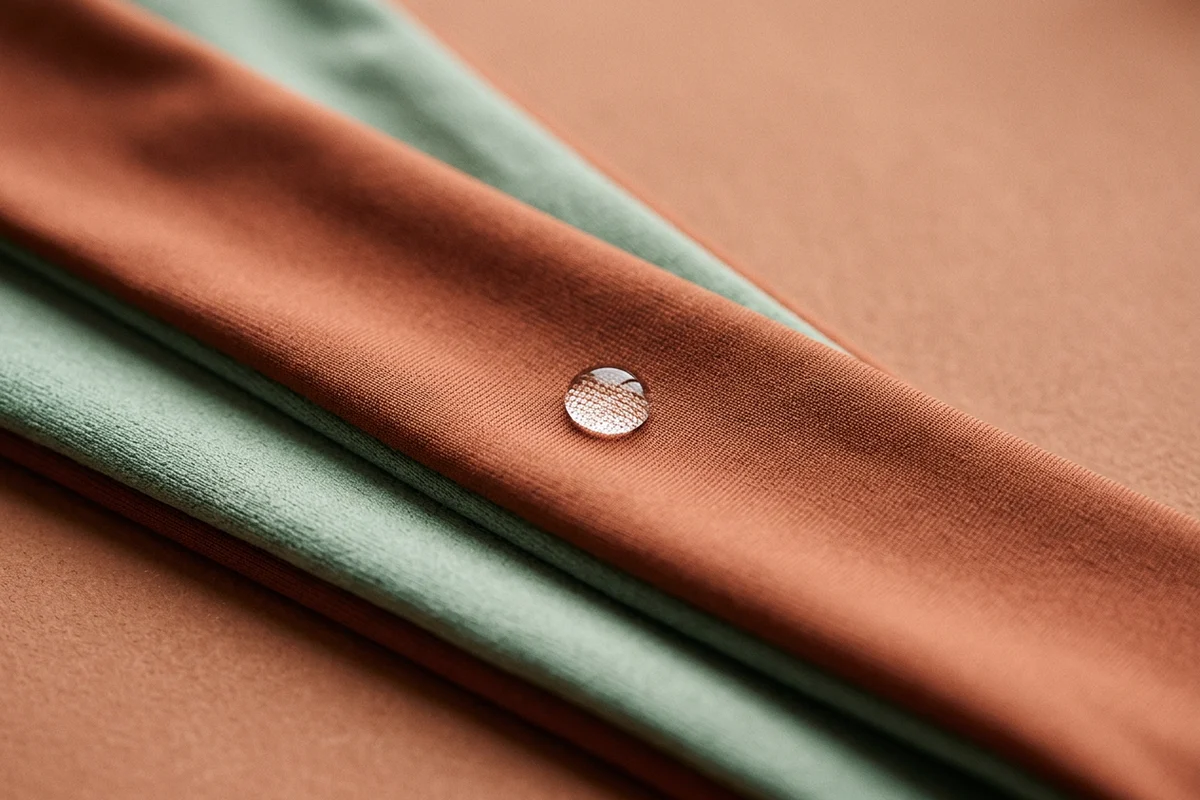
Submerge any porous fabric and water moves freely through its pores until the pressure inside the panel equals the pressure outside. Materials people call that reaching hydrostatic saturation: the gusset equalizes with the surrounding pool water. That is not a failure or a defect. It is physics, and it happens to every period swimsuit ever made, in every brand, at every price. The "waterproof outer layer = nothing seeps through" line that the rest of the search results — and, I'll admit, our own older science-and-style guide — repeated is simply not accurate, and this page supersedes it.
So the honest reframe is this: period swimwear absorbs the blood and manages the water it can't keep out. It works because flow physically slows underwater and a snug fit stops the panel from shifting — not because it's a force field. Once you understand that, the pink puddle stops being a scary mystery and becomes a predictable, manageable thing.
The pink puddle, explained: hydrostatic saturation + gravity
This is the section the rest of the internet won't write honestly, so let's do it properly, step by step.
Step one — underwater, the gusset saturates. The hydrophilic absorbent layer wicks, and the whole panel reaches hydrostatic equilibrium with the water around it: fluid pressure inside the fabric roughly equals fluid pressure outside. Because the pores are open in both directions, a faint, heavily diluted blood-tinted plume can diffuse out through the fabric — which is why, in very clear water, you might catch a wisp. That wisp is mostly water with a trace of pigment, not a flood of blood.
Step two — the actual menstrual blood is still being captured. Real menstrual fluid is heavier and more viscous than pool water; the absorbent core grabs and holds the bulk of it against the polymer or fiber matrix. So the suit is doing its main job even while the panel is water-loaded.
Step three — the puddle happens on EXIT. As you stand up and climb out, two forces act on a fully saturated panel at once: gravity, and the suit's own compression. Together they squeeze the gusset like a sponge, and what gets wrung out is the diluted, blood-tinted pool water it soaked up — running down your legs as that infamous pink puddle. It looks alarming. It is, overwhelmingly, tinted water.
The honest cons here matter: light-colored suits show the tint most — black and dark prints hide it almost entirely. And on a heavy day, the absorbent core can't grab all the menstrual blood, so the water wrung out on exit carries proportionally more pigment and looks pinker. The barrier layer brands advertise — a polyurethane laminate (PUL) on The Period Company, a TPU film on WUKA, a polyurethane barrier on Modibodi — limits seep-through to the outside (it keeps your suit from staining a poolside chair). It does not seal water out of a submerged, already-wet absorbent core. A laminate backing is a backing, not a sealed bag.
Why it works at all: flow slows underwater + compression stops shift
If the gusset can't keep water out, why does period swimwear work for so many people? Two reasons, and neither is magic.
Your flow is physically smaller while you're submerged. Water pressure and the cooler temperature of a pool mean menstrual flow is meaningfully reduced underwater — so the gusset's actual blood load while you swim is small, well within what the absorbent core can hold. (Worth saying plainly: this is general physiology, and swimming on your period is medically fine — that's the consensus among OB-GYNs, not a risk I'm inventing. I leave the clinical specifics to the authorities.) The suit isn't fighting a torrent; it's managing a trickle.
A snug compression fit is what actually prevents leaks. The single biggest variable is fit. A correctly sized, snug gusset stays pressed against your body, which stops free-flow blood from escaping the panel edges and stops the gusset shifting out of position. That's the real engineering. A loose or wrong-size suit defeats the whole system — the panel gapes, blood escapes the sides, and no amount of "4-layer technology" saves it. This is exactly why sizing and a tight fit get harped on, and it's the bridge to the athlete's trick below.
The athlete's secret: underswimming & the "drag suit" layer
Competitive and club swimmers solved the period-swim problem years before the brands caught up, with a technique called underswimming: wearing a period bikini bottom underneath a tight regulation training suit. Often it's disguised to coaches as a "drag suit" — an intentional extra layer swimmers wear for resistance training, so nobody asks questions.
In materials terms, here's why it works so well. The outer compression suit does two jobs the inner panel can't do alone: it dramatically slows water ingress to the inner gusset (less hydrostatic exchange means a less-saturated panel), and it physically pins the inner bottom in place so it can't shift a millimeter. Double compression equals less water loaded into the gusset and zero shift — which means a smaller saturation load and a much smaller exit puddle. It's the closest thing to "leakproof" the physics actually allows.
The honest cons: it's hotter, it's slower to pull on and peel off, and — importantly — it's a workaround, not a product. You're stacking two garments to compensate for what one can't do. For meet-day teens it's a genuinely useful trick; for a casual pool day it's usually overkill. If you swim laps or compete, it's worth knowing.
When it fails: heavy flow, squat leaks & the saggy-diaper problem
I won't oversell this category, so here are the failure modes stated plainly.
Heavy flow overwhelms the core. Those "holds 4 tampons" claims are measured dry in a lab; in water, dilution and saturation shrink the usable capacity, so the real-world ceiling is lower than the box says. For genuinely heavy flow, menorrhagia, PCOS, endometriosis, or postpartum lochia, a swim gusset alone can be outpaced — and at that point swimwear is a confidence layer, not a standalone solution. I'll say that directly because hiding it would be a disservice. If you're dealing with clinically heavy bleeding, that's a conversation for your doctor, not a suit-shopping decision — I'm a materials writer, not a clinician.
The squat leak. If you double up with an internal product, know that a menstrual disc can "auto-dump" — release its contents — when you bear down or squat, which is exactly the motion of sitting on a pool ledge or climbing out. It's a real, common surprise for disc users; cups are more squat-stable.
The saggy-diaper droop. A fully saturated heavy-flow gusset gets heavy and water-logged, and that weight can make the panel sag and read bulky under a swimsuit. It's a cosmetic and comfort con of the highest-absorbency suits specifically — the very thing that makes them hold more is what makes them droop when full.
How to actually stay dry: match absorbency, double up, pick dark fabric
Here's the physics turned into buyable rules.
1. Match the absorbency tier to your real flow. Light backup, medium, and heavy-champ suits are genuinely different products. Don't buy a light The Period Company suit for a heavy day, or pay for a bulky Modibodi Super if you only need a confidence layer. Be honest about your actual flow and buy to it.
2. Double up on heavy days. The single most effective move is layering: the suit plus an internal product (a tampon, a menstrual cup, or a disc), or the underswim technique above. No swimsuit is a standalone tampon or cup replacement at medium-plus flow — and any page implying otherwise is overselling. Pairing the right suit with the right internal product is what actually keeps you dry.
3. Choose dark fabric. Since the pink puddle is tinted water, a black or dark-print suit hides any plume or wrung-out tint almost completely. Light colors are the worst offenders. This is the cheapest insurance there is.
4. Check the gusset coverage front and back, and the width. A gusset that's generous front-to-back and wide enough at the sides prevents the edge-escape and side-leaks that fit-failures cause — especially relevant if you're plus-size and a standard panel runs narrow. Read the size chart, don't guess.
5. Rinse and strip after every swim. Chlorinated, blood-loaded fabric that sits damp grows odor-causing biofilm, and these dense gussets can take 24–48 hours to dry. Rinse cold immediately, and for stubborn odor use an occasional diluted cold vinegar soak to clear the buildup that traps smell (sparingly — overuse can weaken the laminate; the full method is in the how to wash period swimwear guide). (Skip prolonged hot-tub soaks where you can — sustained heat is hard on the waterproof laminate backing over time.)
That's the science. For the brands that actually deliver each tier — the heavy-flow champs versus the backup-only suits, ranked with verified prices and honest cons — see our complete period swimwear buying guide. Below are five real suits that illustrate how the mechanism scales from heavy-champ to budget-tween.
Modibodi Swim Super — the highest absorbency tier
Modibodi Swimwear One Piece – Super
The closest thing to a heavy-flow champ here — the highest lab-rated capacity behind a polyurethane barrier — but it's a premium, discount-dependent buy with a rigid returns policy.
Check price at Modibodi →If you want the most absorbent swim tier on this list, the Swimwear One Piece – Super is it. Modibodi rates the Super gusset to a lab-dry equivalent of about 50ml ("up to 10 tampons"), behind a leak-proof polyurethane barrier layer, in a chlorine-resistant 74% recycled-nylon shell that carries OEKO-TEX STANDARD 100 fabric and sizes US 4/XS through 14/2XL. On the absorbency axis, nothing else here matches it.
Two honest caveats keep it at 4.4, not 5. First, that 50ml is a dry lab-equivalence figure, not an independent underwater-validated number — in the pool, expect less. Second, the gusset is the bulkiest here, which is the saggy-diaper trade-off the absorbency buys, and the returns policy is the real soft spot: opened or worn swimwear is generally non-returnable, return shipping is buyer-paid, and refunds can come back as gift credit. Note too that the US swim gusset is synthetic polyester — not the merino some shoppers expect from the brand's underwear line. Even at this tier, a heavy day still benefits from doubling up.
- Pros: highest absorbency tier here (lab-rated ~50ml); true polyurethane barrier; chlorine-resistant, OEKO-TEX fabric; broad US 4–14 sizing.
- Cons: absorbency is a marketing lab figure, not underwater-validated; bulkiest gusset when saturated; premium, heavily discount-dependent price; rigid, buyer-paid returns on opened swimwear.
WUKA Period Swimsuit — best value with a PFAS-tested gusset
WUKA Period Swimsuit (Racerback)
A real TPU waterproof-backing gusset, UV50+ fabric and brand-tested PFAS-free posture at a genuine $47 — for light-to-medium swimmers, the value pick.
Check price at WUKA →For light-to-medium swimmers who care about fabric posture, WUKA's swim range is the value standout. The 3-layer gusset uses a genuine TPU film as its waterproof backing, the fabric is UV50+ and chlorine-resistant, WUKA is a certified B Corp, and the swim shorts page literally states the products are "PFAs-free tested" (via the brand's commissioned lab). At $47 (on a near-permanent sale from a $67 strike-through), it's the most affordable suit here with a real barrier layer and a transparent chemical stance.
The honest limits: WUKA explicitly does not recommend its swimwear for heavy flow — the gusset caps around 10–15ml (roughly 2–3 tampons), so it's a light-to-medium product, full stop. It's a UK brand, so US buyers face cross-border shipping and buyer-paid international returns, and CS is praised in the UK but spottier internationally. The PFAS-free claim rests on the brand's own testing, not a third-party label, and there's no OEKO-TEX certification on the swim pages — so don't over-read it.
- Pros: genuine TPU waterproof-backing gusset; UV50+, chlorine-resistant fabric; brand-tested PFAS-free; B Corp; real $47 price.
- Cons: light-to-medium only (no heavy-flow option); UK base means cross-border shipping/returns; PFAS claim is brand-lab, not third-party certified; permanent-looking strike-through pricing.
Ruby Love Period Swimwear — best teen / first-period story (with a caution)
Ruby Love Period Swimwear One Piece
The most established teen and first-period swim line with a built-in liner — but a documented fulfillment and refund risk I flag honestly, not a hidden con.
Check price at Ruby Love →Ruby Love built one of the better-known teen and first-period swim lines, with adult and dedicated teen cuts of the Period Swimwear One Piece in several colorways. The liner is built into the suit using absorbent cotton and a "Dri-tech mesh," rated to about 3 tampons — a reasonable medium ceiling — and notably it uses no PUL barrier (the pages state "no swelling in water"), a cotton-based approach some shoppers prefer.
Here's where I have to be straight, because hiding it for commission would be exactly the dishonesty this page exists to fight: Ruby Love carries an "F" rating from the Better Business Bureau (not accredited), driven by a large number of unanswered complaints, and recurring reports of multi-week shipping delays, refunds issued as store credit rather than original payment, and customers initiating chargebacks after orders that never arrived. Pair that with a premium $169.99 price and the spec inconsistencies on the brand's own pages, and I rate it a cautious buy. The product story is good; the fulfillment risk is real — order well ahead of any trip and keep your payment records.
- Pros: established teen/first-period line with dedicated teen sizing; built-in cotton + Dri-tech liner; no-PUL, cotton-based construction; multiple colorways.
- Cons: BBB "F" rating with many unanswered complaints; documented shipping delays and store-credit-only refunds; chargeback reports; premium $169.99 price; spec inconsistencies between adult and teen pages.
The Period Company The Swim. — cheapest suit with a real PUL barrier
The Period Company The Swim.
The cheapest suit here with a genuine 100% polyester PUL barrier — but by the brand's own admission it only absorbs out of the water, so it's a light, in-and-out product.
Check price at The Period Company →The Swim. line (High Waisted and Bikini, $30; teen bikini $28) is the most affordable suit here that still has a genuine waterproof barrier — its absorbent layer is backed by a "100% Polyester PUL" laminate, in a recycled-nylon shell, sized XS–3X. For a budget direct-from-brand option with a real barrier, it's hard to beat the price.
But read the brand's own swim FAQ closely, because it's unusually honest: the suit "won't leak into the water due to water pressure" and is "designed to absorb blood when you're out of the water." In other words, by the company's own statement, the in-pool mechanism is water pressure holding flow back, and absorption happens poolside — it's not an in-water absorption product, and it's rated to only about 2 tampons. That makes it a genuine light / backup tier. Returns are also strict: no refunds, exchange-only on unworn items, store credit only, international sales final.
- Pros: cheapest suit here with a real 100% polyester PUL barrier; recycled-nylon shell; wide XS–3X sizing; very affordable ($28–$30).
- Cons: absorbs out of the water only (by the brand's own FAQ); light ~2-tampon ceiling; no refunds, exchange-only / store credit; PFAS testing documented for underwear, not explicitly the swim line.
Beautikini Period Swimwear One Piece — budget tween pick (Amazon)
Beautikini Period Swimwear One Piece (Teen)
An affordable teen one-piece the brand itself positions for light-to-moderate flow — a budget entry point, not a tested heavy-flow solution.
Check price on Amazon →For the budget end — and especially for a tween in the transitional first-period stage — Beautikini's leakproof racerback one-piece is the affordable entry point, sold through the brand's own Amazon listing and marketed for girls roughly ages 11–14. The layered gusset stacks a quick-dry fleece, a terry absorption layer, a modal core, and a waterproof membrane, with a roughly 85% nylon shell. The brand claims OEKO-TEX and "PFAS-free," though those are self-asserted (I couldn't verify an independent certificate number).
The honest positioning matters here: Beautikini makes swimwear, not underwear, and the brand itself recommends pairing the suit with a tampon or pad on heavier days. Its real, tested use case is light-to-moderate teen flow — the "4-layer / 3-tampon" line is a capacity marketing claim, and heavy-flow standalone performance is untested; I don't claim otherwise. Reviewers also flag inconsistent sizing ("runs large," tight edges) and thin top padding. For a confident, low-cost tween suit it does the job; for heavy flow, look up the tier ladder. If you want the deeper dive on this specific brand, see our explainer on Beautikini's design.
- Pros: affordable budget/tween entry point; teen-specific cut (ages ~11–14); layered membrane gusset; quick-dry fabric.
- Cons: light-to-moderate flow only (heavy untested, brand advises pairing); inconsistent sizing; thin top padding; certifications are self-claimed, not independently verified.
Where the other big names fit (and a word on doubling up)
A few brands you'll see searched alongside these deserve an honest placement rather than a forced ranking.
Knix makes period swimwear, but it belongs in prose, not as a top pick, for one materials reason: its swim gusset is engineered to be a thin, undetectable triple-layer rated to roughly 1–3 tampons — by Knix's own framing, a light-flow backup layer, not a tampon replacement. The PU-film barrier and 85% nylon build are solid, and the teen (KT by Knix) line is well made, but a paper-thin gusset is the opposite of a heavy-flow tool. Treat Knix swim as backup-only, exactly as the brand positions it.
Saalt doesn't make period swimwear at all — its own customer support steers swimmers toward a cup or disc worn under any suit, because its absorbent underwear "soaks up water" and isn't built for submersion. So Saalt's real role here is the double-up: a medical-grade silicone disc or cup (the Saalt Disc holds up to ~50ml and collects rather than absorbs, so it stays effective underwater) worn beneath the swimsuit of your choice. Just remember the squat-leak caveat — discs can auto-dump when you bear down.
That's the practical version of "double up": the right suit for the visible layer, a cup or disc for the heavy-day insurance. For everyday (dry-land) protection if you decide swimwear isn't enough, our guides to period underwear vs. pads and the beginner's period underwear guide cover the rest. And if you're helping a tween through her first period, this first-period letter guide is a gentler place to start.
A note on fabric safety: PFAS, the Thinx settlement & OEKO-TEX
Because I came up as a cosmetic chemist, I get asked the chemical-safety question constantly — and there are genuinely two honest camps, so I'll represent both.
One camp wants certified-clean fabric: OEKO-TEX STANDARD 100 gussets, ideally natural-fiber cores, and treats vague "non-toxic" rebrands as greenwashing. They point to the Thinx PFAS class-action settlement as their reason. Here's that story stated factually: in 2023 Thinx agreed to a settlement of up to $5 million over claims its period underwear contained PFAS despite non-toxic marketing. Critically, a settlement is not an admission of wrongdoing and not a regulatory ban — Thinx denied the allegations, and no agency banned the products. It's a legitimate reason to want third-party-verified fabric; it is not proof that "all period products are toxic."
The other camp has compliance fatigue: PFAS are now so environmentally widespread that even drinking water carries trace levels, so they see the alarm as overblown. That's also fair — context matters, and trace ≠ hazard.
My chemist's middle ground: the one verifiable mark worth looking for is OEKO-TEX STANDARD 100, which lab-tests every component against 1,000+ harmful substances for skin-contact safety — but understand its limits. It certifies chemical safety only; it does not guarantee performance, waterproofness, durability, "eco," or "organic." Brands' own "PFAS-free tested" lines (WUKA's, Beautikini's) cite their own commissioned labs, which is weaker than an independent label — useful, not gospel. So: prefer OEKO-TEX where you can get it, read "non-toxic" as marketing until proven, and don't let either the fear or the fatigue make the decision for you. I take this apart brand by brand — and explain why almost no period swimsuit has ever been independently PFAS-tested — in the full non-toxic & PFAS-free period swimwear guide. For anything about pool chemistry or chlorine exposure itself, the CDC's healthy-swimming guidance is the authority, not me.
Frequently asked questions
Honestly, both yes and no. It captures menstrual blood in an absorbent gusset, but it cannot keep pool water out, so a faint tinted plume can release through the fabric underwater, and a "pink puddle" can appear as you climb out. That puddle is gravity wringing saturated fabric, not a blood flood — choose a dark suit, match the absorbency tier to your flow, and double up on heavy days.
No — and any brand implying "nothing seeps through" is overstating it. The gusset is a hydrophilic absorbent panel held against the body by compression, not a sealed bag, so it reaches hydrostatic saturation underwater and equalizes with the surrounding water. It absorbs blood; it does not waterproof you against pool water. The waterproof backing only limits seep-through onto a chair, it does not seal water out of a submerged panel.
The gusset soaks up pool water until it reaches saturation. On exit, gravity plus the suit's own compression squeeze that saturated panel like a sponge, releasing the diluted, faintly blood-tinted water it absorbed down your legs. It is mostly water with a trace of pigment, not blood, and it is physics every period suit shares. A dark suit hides it, and rinsing right after helps.
Underswimming means wearing a period bikini bottom under a tight regulation training suit; competitive swimmers often disguise the extra layer to coaches as a "drag suit" for resistance training. The outer compression slows water ingress to the inner gusset and pins it in place, cutting both saturation and the exit puddle dramatically. The honest catches: it runs hotter, it's slower to put on, and it's a workaround rather than a purpose-built product.
Treat it as a confidence layer, not a standalone solution. In water, dilution and saturation shrink usable capacity, so "holds 4 tampons" claims often fall short for heavy flow, menorrhagia, PCOS, endometriosis, or postpartum lochia. For those, double up with a cup, disc, or the underswim technique. And defer any clinically heavy-bleeding questions to your doctor — this is materials guidance, not medical advice.
The 2023 Thinx PFAS case was a class-action settlement of up to $5 million, not an admission of wrongdoing or a regulatory ban, and PFAS exposure is far broader than swimwear. Look for OEKO-TEX STANDARD 100 certification, which lab-tests fabric against 1,000+ harmful substances for skin-contact safety — though it does not certify performance or "eco." Read "non-toxic" as marketing until verified, and check the CDC for pool-chemistry questions.