

Affiliate disclosure: This post contains affiliate links. If you buy through them, I may earn a small commission — at no extra cost to you. I only recommend products I'd point a friend to, and my editorial opinions are my own. Full disclosure here.
I'm a former cosmetic chemist, so I'll tell you the thing most period-swimwear care advice dances around: these suits rarely "wear out." They get killed — usually in a single tumble-dry cycle, or slowly, by fabric softener. The expensive part of a period swimsuit is a thin waterproof laminate bonded into the gusset, and that laminate has two mortal enemies: heat and waxy coatings. Treat it right and a good suit lasts years; throw it in the dryer once and you can delaminate the very layer you paid for.
So this is a care guide written from the materials up — what each rule is actually protecting, why your suit starts to smell after a few wears (it's not "dirty," it's biofilm), and the one piece of popular advice — a vinegar soak — that works but comes with a real caution. I'll give you the 60-second routine first, then the chemistry behind it for when you want to know why.
Key Takeaways
- The 60-second routine: rinse cold right after swimming → cold machine or hand wash in a delicates bag → no fabric softener, no bleach, no tumble dryer → hang or lay flat to air-dry (24–48 hours).
- Heat is the #1 killer. The dryer, hot water and the iron all damage the PUL/TPU waterproof barrier — that's what causes the "saggy," no-longer-leakproof gusset.
- Fabric softener is the silent killer. It leaves a waxy coating that clogs the absorbent fibers, so the suit quietly stops absorbing. Never use it.
- If it smells, that's biofilm. A gentle-detergent presoak fixes most of it; an occasional diluted vinegar soak helps more — but use it sparingly, because overuse can weaken the waterproof layers.
- Buy two or three and rotate. A thick absorbent gusset takes 24–48 hours to fully dry, so one suit isn't enough for back-to-back swim days. Care rewards a suit worth caring for — see which ones.
The routine, step by step (do this every time)
Here's the whole thing, in order. It takes about a minute of active effort; the rest is drying time.
- Rinse in cold water immediately after swimming. Straight out of the pool or ocean, rinse the suit in cold water (Modibodi specifies under 30°C / 86°F). This flushes out chlorine, salt and menstrual fluid before they set or degrade the fabric. Cold, not warm — warm water sets blood stains and is harder on the laminate. Don't leave it soaking for hours; a rinse, not a soak.
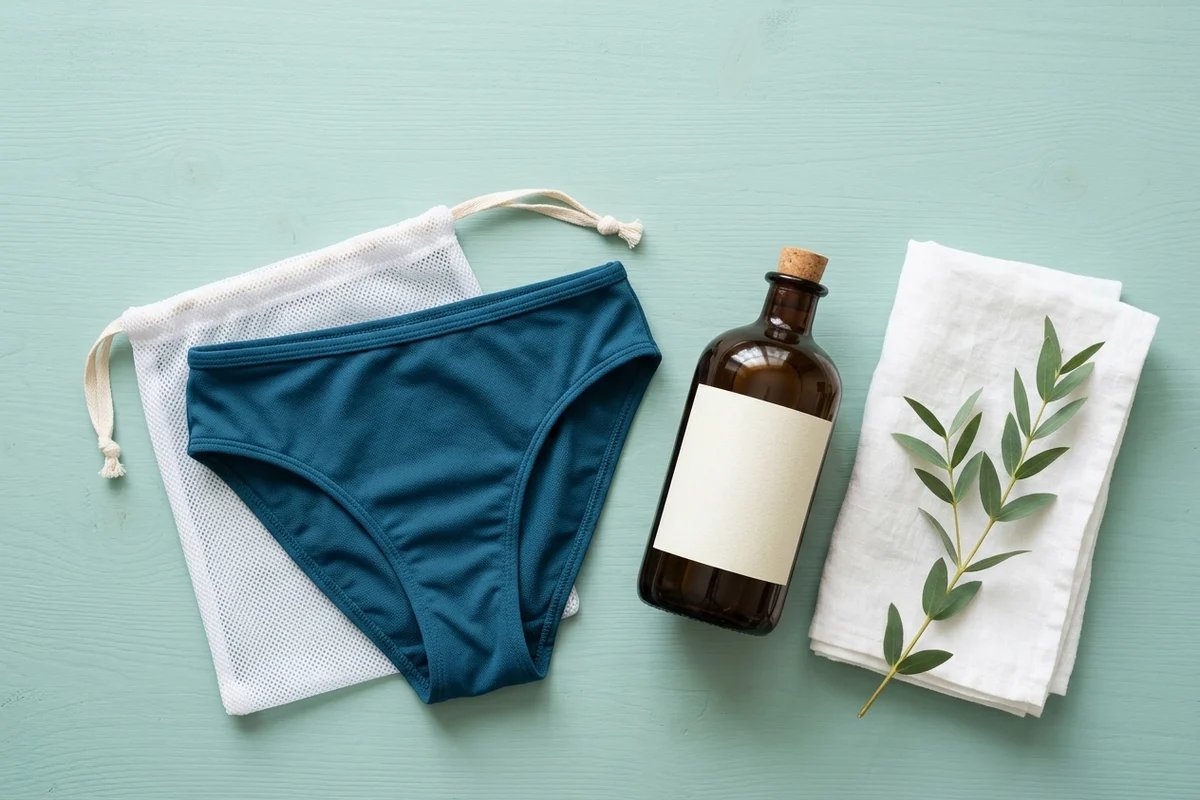
- Wash cold, in a delicates bag. You can hand-wash, or machine-wash on a cold, gentle/delicates cycle — most brands (Modibodi included) are fine with the machine if you use a mesh delicates bag to stop the suit snagging or stretching against zippers and other garments. Use a small amount of a mild, plain detergent.
- No fabric softener. No bleach. This is the rule people break most, and the one that quietly ruins the suit (chemistry below). Skip both, every time.
- Don't wring it — press the water out. Twisting and wringing stresses the laminate bond and the elastic. Instead, gently press the suit, or roll it in a clean dry towel and press, to get the bulk of the water out.
- Air-dry: hang or lay flat, never the dryer. Hang it or lay it flat out of direct harsh sun. A thick absorbent gusset can take 24–48 hours to dry all the way through — which is exactly why you want two or three suits in rotation rather than relying on one.
That's it. Everything below is the "why," so you can adapt it to your own suit and care label — and the official brand instructions always win over a general guide, so read the tag.
Why heat is the #1 killer (the dryer, hot water and the iron)
The reason a period swimsuit works at all is a waterproof barrier laminated into the gusset — usually a polyurethane laminate (PUL) or a thermoplastic-polyurethane (TPU) film. "Thermoplastic" is the tell: these are plastics that soften and deform with heat. Run that laminate through a hot dryer and you can break the bond between it and the fabric — it's called delamination — and once the layers separate, the gusset goes wavy, bubbled or "saggy," and it no longer stops fluid passing through. That's not the suit "wearing out." That's a single heat event destroying the one component you paid extra for. The same physics is why long, hot hot-tub soaks shorten a suit's life, and why you never iron a period swimsuit.
Modibodi's own care page is blunt about it: rinse cold, and "avoid using a tumble dryer, as high heat can damage the fabric and elastic." The same logic extends to hot washes (use cold) and direct high heat of any kind. Heat also degrades the elastane (spandex) that gives the suit its stretch and snug leg seal — and since fit is what actually prevents most leaks, a heat-slackened leg opening leaks even if the gusset is fine. Cold water and air-drying protect both the barrier and the fit.
The silent killer: why fabric softener ruins the suit
This one is sneaky because it doesn't destroy the suit in one go — it quietly suffocates it. Fabric softeners work by depositing cationic surfactants — positively-charged, waxy molecules — onto fibers to make them feel soft. On a cotton T-shirt that's fine. On a technical absorbent fabric, it's a disaster: that waxy film coats the very fibers whose job is to wick and absorb fluid. Under a microscope, a softener-treated fabric looks like it's been dipped in invisible wax; the fibers that should stand up and pull moisture in are coated and "suffocated."
The result is a suit that gets less and less absorbent with every softened wash — and, because the trapped moisture sits on the surface instead of being pulled in, a fabric that holds odor and bacteria more. So fabric softener simultaneously kills the absorbency you bought and makes the smell problem worse. There is no version of "a little is okay." Skip it entirely; the same goes for dryer sheets (same chemistry) and "scent booster" beads. If you want your suit to smell fresh, the answer is in the next section, not in the softener aisle. Bleach is a separate no — it oxidizes both the fibers and the laminate, breaking them down over time.
Why it smells after a few wears — and how to fix it (the vinegar caveat)
If your suit has started to smell faintly "off" even when clean, you haven't done anything wrong and it isn't dirty in the usual sense. What you're smelling is biofilm: a thin, stubborn layer of bacteria and body-oil residue that builds up inside the absorbent core over many wears and shrugs off a normal cold wash. It's the same thing that makes gym clothes smell after a workout even straight out of the laundry. Here's how to deal with it, gentlest option first:
- First, a gentle-detergent presoak. Before a normal wash, soak the suit for 30–60 minutes in cold water with a small amount of mild detergent (or a dedicated "sport wash" made for technical fabrics). This lifts most everyday buildup without touching the laminate, and for most suits it's all you'll need.
- For stubborn odor, an occasional diluted-vinegar soak — sparingly. White vinegar's acetic acid does break down odor-causing buildup, and a 1-part-vinegar-to-4-parts-cold-water soak for ~30 minutes can reset a smelly suit. But here's the honest caution most blogs skip: repeated vinegar (or baking-soda) use can, over time, weaken the protective waterproof layers and the elastic — so treat it as an occasional reset, not a routine, always diluted, and only if your suit's care label allows it. When in doubt, the gentle-detergent soak is the safe default.
- Prevent it in the first place: the cold rinse right after swimming is your best anti-biofilm move, and never let a damp suit sit balled up in a bag for hours — that's biofilm's ideal breeding ground. Make sure it's fully dry (all 24–48 hours) before you store it.
What I'd avoid: heavy baking-soda scrubbing as a habit, "antibacterial" laundry additives (often softener-adjacent), and anything hot to "kill the germs" — heat is still off the table, biofilm or not.
Chlorine, salt and the things that age a suit fastest
Two pool-side habits do most of the long-term damage, and both are easy to fix. Chlorine and salt are hard on elastane and can degrade the laminate over time if they're left to dry into the fabric — so the post-swim cold rinse isn't just about fluid, it's about getting the chemistry out before it sits. And prolonged heat, as covered above, is the accelerator: a long hot-tub soak combines heat with chlorine, which is about the worst single thing you can do to a leak-proof gusset. None of this means you can't enjoy the suit — it means a 20-second cold rinse afterward genuinely buys you extra seasons. If you want the deeper picture of how the gusset actually works (and why it takes on pool water in the first place), I cover that in how period swimwear works.
Before the first wear, and getting out a stain
A quick first wash before first wear is worth it — some brands say it helps "activate" the absorbent layer to full capacity, and it clears any manufacturing residue. For a stain, the rule is the same as the whole guide: cold water only. Rinse fresh menstrual fluid under cold running water from the back of the gusset (so you're pushing it out, not deeper in), then wash as normal. Never use hot water on a blood stain — heat sets the proteins and locks the stain in. An enzyme-based or gentle stain treatment is fine if you spot-test first; bleach is not.
Suits that actually reward the care: 1. Modibodi
Modibodi Swimwear One Piece – Super
A real polyurethane-laminate gusset, OEKO-TEX fabric and the clearest official care guide of any brand — the construction most worth the cold-wash, air-dry routine.
Check price at Modibodi →Good care pays off most on a suit built to last, and Modibodi is the clearest example: a genuine polyurethane leak-proof layer, chlorine-resistant recycled-nylon shell, and an explicit care page that tells you exactly what this guide does (rinse cold, delicates bag, no softener, no dryer). Treated that way, the laminate holds up for years. It's also the heavy-flow and chemical-safety pick across the cluster — more in the full period swimwear guide.
2. WUKA — the value suit worth the small care effort
WUKA Period Swimsuit (Racerback / Scoopback)
A genuine 3-layer TPU-barrier gusset on a B Corp suit at a gentle price — cold-wash it and skip the dryer and it'll outlast pricier suits washed carelessly.
Check price at WUKA →At around $47, WUKA proves good care matters more than a high price tag: its TPU waterproof film is a real barrier, and on cold-wash, air-dry treatment it lasts well past what you'd expect for the money. It's light-to-medium flow only and ships to the US from the UK — the honest trade-offs — but as a value suit that rewards a one-minute care habit, it's the one I'd point a budget buyer to. The full ranking, including heavy-flow and teen options, is in the period swimwear guide.
When to retire a suit (and how to tell)
Even well-cared-for, a period swimsuit isn't forever — but with this routine you're looking at years, not a season. The signs it's genuinely done: the gusset feels stiff, bubbled or separated (delamination — usually a heat casualty), the leg or waist elastic has gone slack so the suit no longer sits snug (most leaks are a fit failure, not an absorbency one), or you're getting leaks that a fresh, well-fitted suit wouldn't. A persistent smell that survives a gentle soak and an occasional diluted-vinegar reset is the absorbent core finally giving up. At that point, replace it — and start the new one off right with a cold first wash.
Frequently asked questions
Yes — most brands, including Modibodi, allow a cold, gentle/delicates machine cycle, ideally with the suit inside a mesh delicates bag to protect it from snagging and stretching. The non-negotiables are cold water, no fabric softener, no bleach, and no tumble dryer afterward. If your suit's care label says hand-wash only, follow the label. Either way, rinse it in cold water right after swimming first.
No — this is the single most damaging thing you can do. The waterproof gusset is a heat-sensitive PUL or TPU laminate, and a hot dryer can delaminate it (separating the layers so it no longer stops leaks) and degrade the stretchy elastane that keeps the suit fitting snugly. Always hang or lay it flat to air-dry. A thick absorbent gusset takes 24–48 hours to dry fully, which is why it's worth owning two or three to rotate.
That's biofilm — a stubborn layer of bacteria and body-oil residue that builds up inside the absorbent core over many wears and survives a normal cold wash, the same way gym clothes can smell straight out of the laundry. Fix it with a 30–60 minute presoak in cold water and a little mild or sport-specific detergent before your normal wash. For stubborn cases, an occasional diluted white-vinegar soak (1 part vinegar to 4 parts cold water) helps — but use it sparingly, as repeated use can weaken the waterproof layers, and check your care label first.
Occasionally and cautiously, yes — a diluted white-vinegar soak (1:4 with cold water, about 30 minutes) can break down odor buildup. But it should be an occasional reset, not part of every wash: repeated vinegar or baking-soda use can, over time, weaken the protective waterproof laminate and the elastic. Always dilute it, only do it if your suit's care label allows, and reach for a gentle-detergent presoak as your everyday option. Never use bleach.
Fabric softener coats fibers with a waxy, water-repellent film to make them feel soft — which is exactly the opposite of what an absorbent gusset needs. That coating clogs the wicking and absorbent fibers so the suit takes on less fluid, and because moisture then sits on the surface, it actually holds odor and bacteria more. The damage builds up with every softened wash. The same applies to dryer sheets and scent-booster beads. Use only a small amount of plain, mild detergent.
With cold washing, no fabric softener and air-drying, a quality period swimsuit can last several years. The things that cut its life short are heat (the dryer, hot washes, long hot-tub soaks), fabric softener, and leaving chlorine or salt to dry into the fabric. Retire a suit when the gusset feels stiff, bubbled or separated (delamination), when the elastic goes slack so it no longer fits snugly, or when leaks appear that a fresh, well-fitted suit wouldn't.