

Affiliate disclosure: This post contains affiliate links. If you buy through them, I may earn a small commission — at no extra cost to you. I only recommend pieces I'd point a friend to, and my editorial opinions are my own. Full disclosure here.
I spent years in a cosmetic R&D lab reading spec sheets, and the thing I've learned about "waterproof" jewelry is that the word does a lot of heavy lifting in marketing and almost none of it is regulated. There's no IP rating on a necklace. So this guide ranks the best waterproof jewelry brands of 2026 the way a materials person would: by what the metal actually is, what the coating actually does, and whether the brand's own care page quietly tells you to take it off before you swim.
Key Takeaways
- Three tiers, not one: solid gold is truly water-inert; PVD-coated 316L steel is extremely water-durable but the color is a finite coating; vermeil and gold-plated brass are generally not water-safe no matter what the homepage says.
- Best value: Stylr — 18k-gold PVD over 316L surgical steel, $24–$56, with a 1-year color warranty.
- Buy-it-for-life: Mejuri solid 14k — the only material that physically cannot tarnish.
- Read the care page, not the banner: if a brand tells you to remove a piece before showering or swimming, it is water-resistant at best — I left those out of the ranking on purpose.
How I evaluated these brands
This isn't a lab test, and I'm not going to pretend I salt-sprayed 40 necklaces for six months. What I did do is read each brand's own material specs and care instructions, cross-check the metallurgy against published sources, and rank on four things: (1) the base metal and coating a piece is actually made of, (2) whether the brand makes a real water claim or hedges it, (3) price and warranty, and (4) honesty — does the marketing match the fine print? Any brand whose own care page says "remove before water" didn't make the list, however pretty the catalog.
The best waterproof jewelry brands at a glance
| Brand | Material | Water reality | From | Warranty |
|---|---|---|---|---|
| Stylr (best value) | 18k gold PVD on 316L steel | Shower/sweat/pool safe; coating finite | $24 | 1-yr color |
| Mejuri (solid gold) | Solid 14k gold | Truly water-inert (solid line only) | ~$200+ | 2-yr (defects only) |
| Hey Harper | PVD on stainless steel | Shower/sweat safe; coating finite | ~$40s | Lifetime color |
| Ellie Vail | PVD 18k on stainless steel | Shower/sweat safe; coating finite | $68 | None (14-day returns) |
| Ana Luisa | Mixed: steel / vermeil / solid | "Water-resistant"; varies by piece | ~$55 | 2-yr |
| Marrin Costello | 14k gold-plated steel | Water-resistant; coating finite | $78 | 1-yr repair |
| Atolea | PVD on surgical steel | Shower/sweat safe; coating finite | ~$40s | Lifetime color |
1. Stylr — best value waterproof jewelry

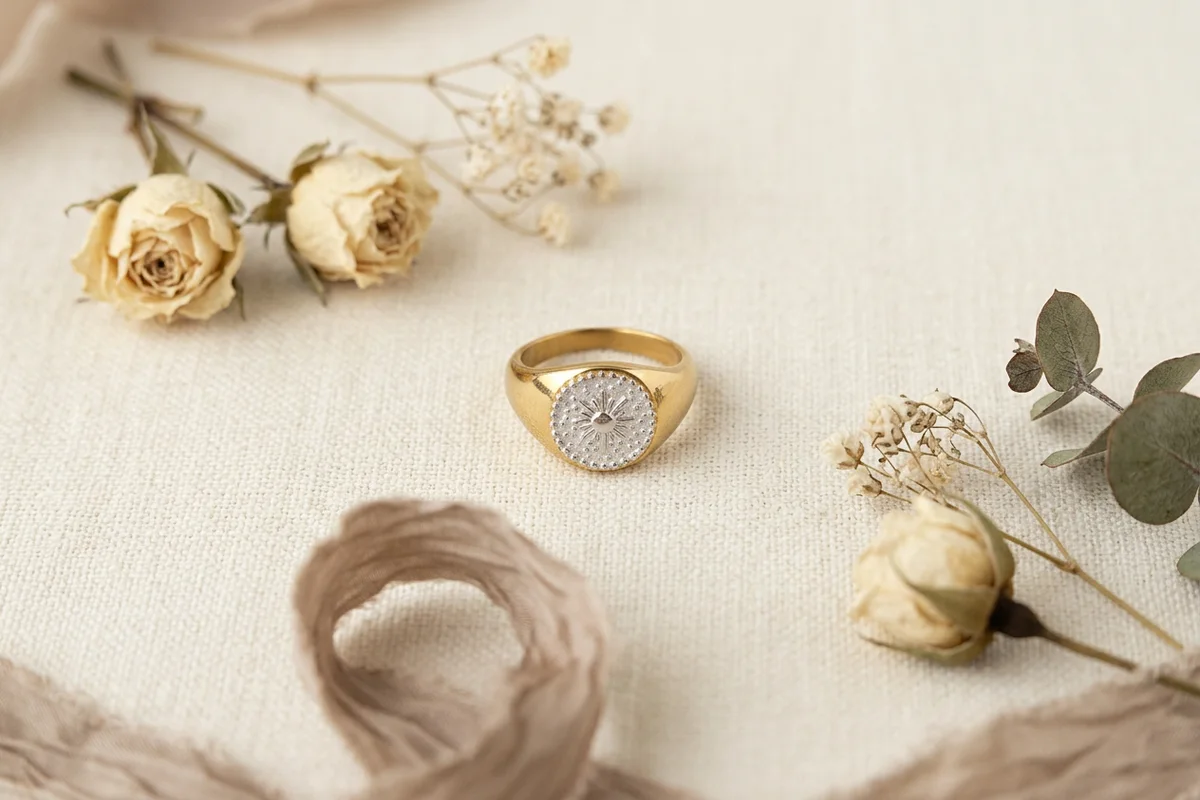
Stylr Two-Tone Sunburst Signet Ring
Best value: real 316L surgical-steel cores with PVD-style 18k plating that shrugs off showers, sweat and pools, priced $24–$56 with a 1-year color warranty. Plating is a coating (not solid gold), but for everyday water wear nothing else at this price holds up as well.
Check price at Stylr →Stylr's whole catalog is built on the material combination I'd recommend to most people who want jewelry they never have to think about: 18k gold applied by PVD over a 316L surgical-stainless-steel core. That's the same steel used in body-piercing posts, and PVD (more on that below) is a far harder, better-bonded coating than ordinary electroplating. Pieces run $24–$56 and carry a 1-year color warranty.
I'm ranking it first on value, not on permanence — and I want to be precise about that. The gold here is a coating. It's a very durable coating that handles showers, sweat and pools, but it is not solid gold and it won't outlast a 14k chain you hand down to your kid. For everyday "wear it in the shower and forget it" jewelry at this price, though, nothing else on this list matches it.
- Pros: real 316L steel core; hard PVD 18k coating; genuinely shower/pool/sweat-rated; 1-year color warranty; budget pricing.
- Cons: plating is finite (not solid gold); a young brand without a long independent review history yet.
2. Mejuri — best solid-gold (buy-it-for-life)
Mejuri Solid 14k Gold
The gold standard, literally. Solid 14k will never rust, corrode or wear through in water. The catch is price and the easy mistake of buying their vermeil tier, which is not water-safe.
Check price at Mejuri →If you want jewelry that is physically incapable of tarnishing or losing a finish in water, you want solid gold, and Mejuri is the cleanest mainstream place to buy it. Their own guidance says it plainly: "Solid gold won't rust or corrode in water." Gold is a noble metal — it doesn't react with water or air — so a solid 14k chain can live in the shower, the ocean and the gym indefinitely.
Two honest caveats. First, price: solid gold starts around $200 and climbs fast. Second, and this trips people up constantly, Mejuri's vermeil and plated tiers are not water-safe — the brand says plating "can wear off with repeated exposure to water." Buy the solid-gold line, or you've bought a different product than the one I'm recommending here.
- Pros: truly water-inert; never tarnishes; lifetime piece; recycled-gold sourcing.
- Cons: expensive; easy to accidentally buy the non-waterproof vermeil tier.
3. Hey Harper — the waterproof specialist
Hey Harper
A purpose-built waterproof brand. PVD-on-steel plus a replace-if-it-fades warranty is a strong active-wear proposition; pricing sits a notch above budget steel.
Check price at Hey Harper →Hey Harper calls itself "The Original Waterproof Jewelry Brand," and it backs the steel-plus-PVD recipe with the strongest promise in the category: a lifetime color warranty — if a piece tarnishes, they replace it. The brand even explains the metallurgy correctly, describing stainless steel's "passive layer of chromium oxide, which shields it from corrosion," finished with PVD.
- Pros: purpose-built for water; PVD-on-steel; replace-if-it-fades lifetime warranty.
- Cons: gold tone is a coating, not solid; pricing runs a step above budget steel brands.
4. Ellie Vail — the original (since 2014)
Ellie Vail Camden Tennis Choker
A waterproof-native brand with a long track record and clean, affordable pricing. Gold tone is PVD plating over steel, so the color is coating-finite like any plated piece.
Check price at Ellie Vail →Ellie Vail says it launched the first waterproof jewelry line back in 2014, and the catalog is exactly what you'd expect from a decade of practice: PVD 18k plating over stainless steel, clean everyday silhouettes, and approachable prices (the Camden Tennis Choker is $90, the Duke Cigar Ring $68). It's a safe, well-priced pick for someone who wants tested-by-time over trendy.
- Pros: long waterproof track record; transparent pricing; broad everyday range.
- Cons: plated gold tone (coating-finite); the brand doesn't publish the exact steel grade.
5. Ana Luisa — best mid-range, with a caveat
Ana Luisa
A testing-backed water-resistance claim plus a 2-year warranty. Read the material on each piece — the "waterproof" collection spans solid gold to vermeil, and vermeil still wears with heavy water exposure.
Check price at Ana Luisa →Ana Luisa says its jewelry is "tarnishproof, water-resistant, and hypoallergenic" and puts a 2-year warranty behind it — one of the few brands to insure against tarnishing rather than just claim it won't happen. The honest wrinkle is that its "waterproof" collection mixes stainless steel, gold vermeil and even solid gold, so durability swings widely by piece — the brand itself notes that only its solid-gold line is fully nickel-free. Check the material on the exact item before you assume it's pool-proof.
- Pros: testing-backed claim; 2-year warranty that covers tarnishing; wide price ladder.
- Cons: "waterproof" collection spans very different materials; vermeil pieces still wear with heavy water use.
6. Marrin Costello — best for bold stacks
Marrin Costello Rosary
Clean water-resistant + non-tarnish claim on a steel base, with a big stackable catalog. The gold tone is plated, so expect the color layer to be finite under abrasion.
Check price at Marrin Costello →If your taste runs chunkier — Cuban links, carabiners, statement chains — Marrin Costello builds them on a "hypoallergenic, non-tarnish, and water-resistant stainless steel base," with a 14k gold-plated finish on the gold colorways. The Rosary 3mm is a representative $78. As with any plated piece, the steel core is water-safe but the gold color is a finite layer.
- Pros: clear water-resistant claim; great for bold, stackable looks; steel base.
- Cons: gold tone is plated; pricier than basic steel brands.
7. Atolea — best budget warranty
Atolea Jewelry
Aggressive lifetime color warranty and budget pricing. "Never lose color" is a strong absolute for any PVD coating, so lean on that warranty.
Check price at Atolea →Atolea leans into an ocean theme and an aggressive promise: surgical-steel-plus-PVD pieces it says "will never lose color," backed by a lifetime color warranty, at budget prices. "Never lose color" is a strong absolute for any coating, so the real value here is that warranty — if you live in the water and want cheap pieces you can replace for free, it's a sensible pick.
- Pros: lifetime color warranty; budget pricing; beachy designs.
- Cons: "never fade" is an overclaim for PVD; storefront pricing shown in EUR for some regions.
How to choose waterproof jewelry that actually lasts
The whole game is understanding what's under the gold color. Here's the materials-science version, kept short.
Solid gold is the only truly water-inert option. Gold is a noble metal; it doesn't form oxides or sulfides, so it can't rust or tarnish. (The discoloration people see on cheap "gold" jewelry isn't the gold — it's the alloy metals like copper and silver reacting.) The trade-off is cost.
316L stainless steel is the budget hero, and the "L" matters. 316L's corrosion resistance comes from a self-repairing chromium-oxide passive film; the molybdenum in 316 (which cheaper 304 lacks) is what helps it resist the chloride pitting you get from sweat and seawater. Peer-reviewed work on 316L describes how that passive oxide film re-passivates to suppress pitting — which is the real reason a 316L core survives water.
PVD is why a coated piece can be "waterproof" at all. Physical vapor deposition bonds the gold-tone layer to the steel inside a vacuum chamber at a molecular level, producing coatings around 2,000–3,000 Vickers hardness versus roughly 200–600 for ordinary electroplating. That's the difference between a finish that lasts years and one that wears off in weeks — but it's still a finish, and abrasion, chlorine and perfume will shorten its life.
Know the legal words. "Vermeil," "gold-filled" and "gold-plated" aren't vibes — the U.S. FTC defines them in 16 CFR Part 23 (vermeil, for instance, requires a sterling base and at least 2.5 microns of ≥10k gold). None of those describe PVD-on-steel, which is its own category — so don't expect a "gold-plated brass" piece to behave like a steel-cored one in the pool. If a brand's care page says remove before water, believe the care page.
Materials that don't belong in the water
Everything above is about metal. But a lot of jewelry sold under a "waterproof" banner isn't solid metal at all — it has organic or porous parts that water quietly ruins, however good the chain is. As a materials person, these are the ones I take off before the shower:
- Pearls. A pearl is organic — layers of aragonite (calcium carbonate) bound by conchiolin and water — and soft, only Mohs 2.5–4. It's porous, so it drinks in sweat, chlorine, perfume and lotion, which dull the nacre and can make it crack or flake. The old rule holds: pearls go on last, come off first.
- Opals. Opal is hydrated silica that is literally 3–21% water. "Hydrophane" opals soak up water like a sponge, and as that water leaves the stone can craze — fine surface cracks that kill the play-of-color. Doublets and triplets add a glued layer water can seep into.
- Turquoise. Porous and often dyed or stabilized; per the GIA it absorbs oils and chemicals and can change color permanently. Never steam or ultrasonic it.
- Emeralds. The large majority are fracture-filled with oil or resin to improve clarity — and hot water or steam sweats that filler right back out, so even your dishwater is a risk.
- Sterling silver. 925 silver is 92.5% silver and about 7.5% copper — and it's the copper that tarnishes in water, air and sulfur; saltwater and chlorine just speed it up. It is not a waterproof metal.
- Enamel. Fired (vitreous) enamel is glass fused to metal: water-resistant, but it chips on impact and chlorine or saltwater can frost the surface over time. "Cold" resin enamel isn't water-safe at all. Either way, take it off to swim.
None of this contradicts the metal ranking above — it just means "is the brand waterproof?" and "is this piece waterproof?" are two different questions. A PVD-steel chain is pool-proof; the same brand's pearl pendant is not.
How to make waterproof jewelry last
"Waterproof" buys a lot of forgiveness, but a PVD coating is still a finish — and a few free habits are the difference between color that lasts years and color that fades in months:
- Rinse after the pool or ocean. Chlorine and salt are what actually wear a PVD finish — not plain water. A quick fresh-water rinse after swimming or a heavy sweat clears the residue before it builds up (a point waterproof brands like Atolea make themselves).
- Pat it dry. Don't let it air-dry — hard-water minerals left behind dull the surface. A soft cloth takes two seconds.
- Cosmetics first, jewelry second. Perfume, lotion, sunscreen and hairspray are harder on plating than water is; put them on, let them dry, then add the jewelry. Ellie Vail flags this one explicitly — "avoid all contact with lotions and perfumes."
- Skip abrasives and ultrasonic cleaners. Mild soap, lukewarm water and a soft cloth — no scrubbing pads, no harsh chemicals, and never an ultrasonic on a piece with pearls, opals or glued settings.
- Store it dry and separated. A soft pouch or a lined box, pieces not touching, so they don't scratch each other.
Do this — especially the chlorine rinse — and a good PVD-on-steel piece earns its "waterproof" label for years. Skip it, and even the best coating fades faster than it should.
Frequently asked questions
There's no regulated IP rating for jewelry, so "waterproof" is a marketing term. In practice, solid gold is genuinely water-inert, and PVD-coated 316L stainless steel handles showers, sweat and pools very well. What isn't reliably water-safe is gold vermeil or gold-plated brass — those are coatings over reactive base metals, and most brands that sell them tell you in the care instructions to remove them before water.
Yes, for everyday showering, sweating and occasional swimming, PVD-on-316L is built for it. The thing that shortens a PVD coating's life isn't plain water — it's chlorine, salt, perfume, lotions and abrasion. Rinsing with fresh water after the pool or ocean and drying the piece meaningfully extends how long the gold tone lasts.
Brands use them loosely, but the practical line is the care page. "Water-resistant" usually means the piece tolerates incidental contact but should come off before showering or swimming — common for gold vermeil and plated brass. "Waterproof" should mean you can wear it in water routinely, which realistically only applies to solid precious metals and PVD-coated stainless steel.
Solid gold won't tarnish at all. PVD-coated 316L resists tarnish for a long time because the steel's chromium-oxide layer protects the core and the PVD finish is hard and well-bonded — but the gold-tone color is still a coating that can eventually wear at high-friction points. Vermeil and plated brass tarnish fastest once the thin gold layer is breached and the base metal is exposed.
Often, yes — 316L surgical stainless steel and solid gold are widely tolerated. But "hypoallergenic" isn't the same as "nickel-free": 316L contains roughly 10–14% nickel, bound in the alloy and released at very low levels. Most people are fine; if you have a confirmed nickel allergy, look at implant-grade titanium, niobium or solid gold instead. I go deeper in my guide to hypoallergenic earrings for sensitive ears.
This guide is part of my complete guide to everyday jewelry that survives real life. Want to go deeper on the gold-tone question specifically? See my guide to the best affordable gold-tone jewelry that won't tarnish, or read my full Stylr review for a closer look at my top value pick.