

Affiliate disclosure: This post contains affiliate links. If you buy through them, I may earn a small commission — at no extra cost to you. I only recommend pieces I'd point a friend to, and my editorial opinions are my own. Full disclosure here.
"Gold jewelry that won't tarnish" is one of the most searched — and most misleading — phrases in jewelry. Here's the chemistry that nobody puts on the product page: pure gold literally cannot tarnish. It's a noble metal; it doesn't react with air or water. So when a "gold" piece turns your neck green or goes dull, it was never really the gold — it was the cheaper metal underneath. As a former cosmetic chemist, let me translate the labels (with the actual FTC definitions), then rank the best affordable gold-tone jewelry that won't tarnish in 2026.
Key Takeaways
- Gold doesn't tarnish — its alloys do. Tarnish comes from base metals (copper, the brass core), not the gold itself. The more real gold and the better the base, the longer it lasts.
- The durability ladder: solid gold > gold-filled > vermeil (sterling + ≥2.5µm ≥10k gold) > gold-plated > gold-flashed. PVD on stainless steel is its own category — the most tarnish-and-water-durable budget finish.
- Best affordable value: Stylr (PVD 18k on 316L steel, from $24).
- Watch the fine print: "anti-tarnish" doesn't mean "waterproof." Some popular plated-brass brands tell you, in their own care guides, to take the piece off before water.
First, the labels — what the FTC actually requires
Most articles use "vermeil," "gold-filled" and "gold-plated" interchangeably. They're not interchangeable — the U.S. Federal Trade Commission defines each one in 16 CFR Part 23, the Guides for the Jewelry Industry. Here's the ladder, thickest gold to thinnest:
| Term | What it legally means | Tarnish resistance |
|---|---|---|
| Solid gold (14k/18k) | Gold all the way through; karat = gold content | Highest — gold can't tarnish (alloys may dull slightly) |
| Gold-filled | Bonded karat-gold layer ≥ 1/20 (5%) of total weight | Very high — thick bonded layer, lasts years |
| Vermeil | Sterling-silver base + ≥10k gold, ≥2.5 microns thick | High — but it's a coating that wears eventually |
| Gold-plated / electroplate | Any base + ≥0.175 microns of ≥10k gold | Low–medium — thin; brass base tarnishes once breached |
| PVD on 316L steel | Not an FTC gold term — a vacuum-bonded coating on steel | High value — hard coating + corrosion-resistant core |
The practical takeaway: "gold-plated" is the weakest of the gold terms and the one most likely to tarnish — unless it's PVD on stainless steel, which behaves completely differently from gold-plated brass (more on that next). For affordable non-tarnish jewelry, you want either a thick layer (gold-filled, true vermeil) or a hard coating on a non-reactive core (PVD on 316L).
Why PVD-on-steel punches above its price
Two material facts explain why a $40 PVD-on-steel chain can out-survive a $40 gold-plated-brass one. First, the base: 316L stainless steel resists corrosion via a self-repairing chromium-oxide layer, so even if the gold color wears, the core won't rust or turn your skin green like brass does. Second, the coating: PVD (physical vapor deposition) bonds the gold layer to the steel in a vacuum at a molecular level, producing a finish roughly 2,000–3,000 Vickers hardness versus about 200–600 for ordinary electroplating. Harder coating + non-reactive base = the most tarnish-resistant finish you can get without paying for solid gold. It's still a coating, so abrasion and chemicals will eventually wear it — but it's the budget winner.
1. Stylr — best affordable non-tarnish value

Stylr Isla Rope Necklace (18k Gold-Plated 316L)
Best value: PVD-on-316L is the budget finish that genuinely resists tarnish and water, because the steel core is corrosion-resistant and the PVD coating is far harder than ordinary electroplating. Not solid gold, but pound-for-pound the best non-tarnish value here.
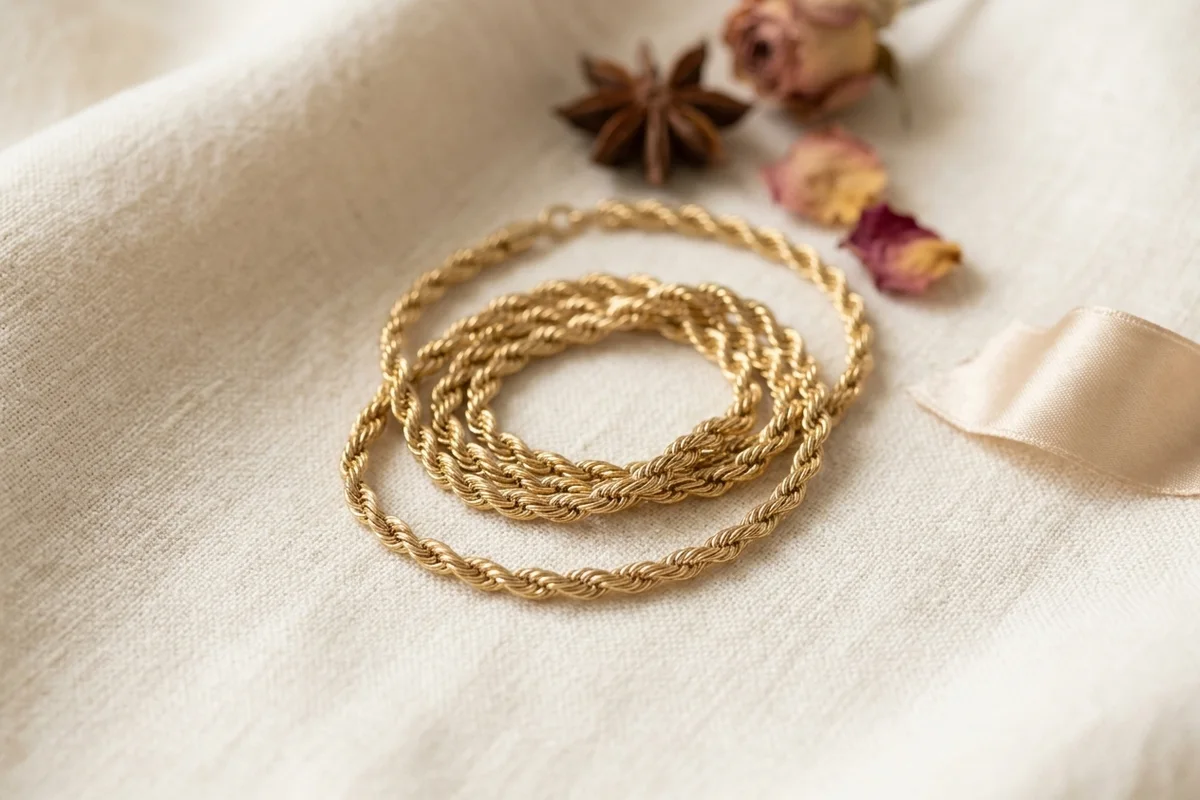
Check price at Stylr →Stylr is the clearest expression of the PVD-on-316L recipe at a budget price: 18k gold applied by PVD over a 316L stainless-steel core, sold as waterproof and tarnish-free, with a 1-year color warranty. Pieces start around $24 and top out in the $50s. The Isla Rope Necklace ($43) is a perfect everyday example — a gold rope chain you can shower in, sweat in and layer daily without watching it go dull.
Honest framing: this is the best value for non-tarnish gold tone, not the most permanent gold on earth. The 18k is a coating, so given enough years and abrasion the color can wear at friction points. But for the price, the combination of a corrosion-resistant steel core, a hard PVD finish and a color warranty is the strongest non-tarnish proposition in the budget tier.
- Pros: PVD-on-316L (best budget non-tarnish finish); waterproof; 1-year color warranty; $24–$56.
- Cons: gold tone is a coating (not solid/vermeil); younger brand without a long review history.
2. Mejuri — best true vermeil
Mejuri 18k Gold Vermeil
Best vermeil. Meets and beats the FTC vermeil bar (≥2.5 microns over sterling), so it outlasts generic "gold-plated." Still a coating that wears eventually, and priced well above steel.
Check price at Mejuri →If you want a thicker, more premium coating than steel-plating, Mejuri's vermeil is the benchmark: a 2.5-micron layer of 18k gold over sterling silver — never brass, which the brand notes is five times the 0.5-micron industry minimum. That's real, FTC-grade vermeil, and it'll outlast generic "gold-plated" by a wide margin. Bold Huggie Hoops are $118. The trade-off is price and the reality that vermeil is still a coating that wears over time — and Mejuri doesn't market it as waterproof.
- Pros: genuine 2.5µm vermeil over sterling; far more durable than thin plating; beautiful designs.
- Cons: 2–3× the price of steel-based picks; coating still wears; not sold as waterproof.
3. Pavoi — best budget (with an honest two-tier)
Pavoi Vermeil & Gold-Plated
Best budget. The cheapest credible entry, and refreshingly honest that its plated line oxidizes with water while its vermeil is the durable tier. Just pick the right one.
Check price at Pavoi →Pavoi is the cheapest credible name here, and I respect that it tells the truth about its own range. It sells a 2.5-micron 14k vermeil over sterling tier and a cheaper 14k-plated tier over brass/sterling — and it openly says the plated line "is likely to oxidize when exposed to water, sweat, perfumes." Pavé hoops start at $16.95. Buy the vermeil tier for longevity, the plated tier for try-it-cheap pieces, and don't expect the plated ones to survive the gym.
- Pros: lowest entry price; honest tier disclosure; vermeil option is genuine 2.5µm.
- Cons: the budget hoops are thin plating that oxidizes with water/sweat — pick the right tier.
4. Ana Luisa — best warranty backing
Ana Luisa
Best warranty backing. The "tarnishproof" claim is insured by an actual 2-year warranty that covers tarnishing — a real backstop. Read the material per piece; only the solid-gold tier truly never tarnishes.
Check price at Ana Luisa →Ana Luisa calls its pieces "tarnishproof, water-resistant, and hypoallergenic," and unlike most brands it puts a 2-year warranty that explicitly covers tarnishing behind that claim — a real backstop if a piece lets you down. The catalog spans solid gold, vermeil and gold-plated, so check the material on each item; only the solid-gold tier is truly tarnish-proof forever. GIULIA Bold Huggie Hoops are $60 (less for members).
- Pros: warranty that actually covers tarnishing; recycled materials; broad price ladder.
- Cons: "tarnishproof" is a claim hedged by a warranty, not an absolute; durability varies by material tier.
5. PDPAOLA — best sterling-based plated
PDPAOLA
Best sterling-based plated. The sterling base beats brass for skin-friendliness and slower tarnish, but it is sold as standard gold-plated (no stated micron/PVD), so longevity is unspecified.
Check price at PDPAOLA →PDPAOLA plates its 18k gold tone over 925 sterling silver rather than brass — and that base metal matters. Sterling is far less likely than brass to cause green marks or fast tarnish once any plating thins. The Essential Necklace is $125. The honest limitation: it's sold as standard "gold-plated" with no stated micron thickness or PVD, so I'd put its longevity below true vermeil and PVD-on-steel — but its skin-friendliness is a real plus.
- Pros: sterling base (better than brass); strong design language; less reactive on skin.
- Cons: standard plating with unstated thickness; pricier than steel for an unspecified coating.
6. Gorjana — the famous name, with the biggest caveat
Gorjana
Best-known name, biggest caveat. The "anti-tarnish barrier" is real but it is plated brass and the brand tells you to remove it before water, hand-washing or exercise — so treat it as careful-wear, not set-and-forget.
Check price at Gorjana →Gorjana is probably the most recognizable brand on this list, and its fashion line is 18k gold-plated brass with an "anti-tarnish barrier." The pieces are lovely (the Parker Necklace is $70). But this is the perfect example of why you read the care page, not the banner: Gorjana's own care guide tells you to "avoid contact with water… remove jewelry prior to exercise, washing your hands or swimming." So the "anti-tarnish barrier" is real, but it's careful-wear jewelry over a brass base — not the set-and-forget, shower-in-it kind. Buy it for the look, baby it like the brass it is.
- Pros: well-known brand; anti-tarnish-treated; popular everyday designs.
- Cons: brass base; the brand itself says remove before water — the weakest "won't tarnish" pick here for daily water wear.
Frequently asked questions
Solid gold never truly tarnishes because gold is a noble metal that doesn't react with air or water (lower karats can dull slightly as the alloy metals react). For affordable options, the most tarnish-resistant are gold-filled (a thick bonded layer), true vermeil (≥2.5 microns of ≥10k gold over sterling), and PVD gold on 316L stainless steel. Thin gold-plated brass tarnishes the fastest.
Yes, considerably. PVD (physical vapor deposition) bonds the gold layer to the metal in a vacuum, creating a coating roughly 2,000–3,000 Vickers hardness versus about 200–600 for standard electroplating. Combined with a corrosion-resistant 316L stainless-steel base, PVD pieces resist tarnish and water far better than gold-plated brass — which is why they can be marketed as waterproof while plated brass cannot.
Both are gold coatings, but the FTC defines them differently. Vermeil legally requires a sterling-silver base and at least 2.5 microns of gold of at least 10 karat. "Gold-plated" (electroplate) only requires 0.175 microns of gold over any base metal — including brass. So vermeil has roughly 14× the minimum gold thickness on a precious base, which is why it lasts much longer than ordinary gold-plated jewelry.
The green is usually copper from a brass base metal reacting with moisture and skin acids once the thin gold plating wears through — it isn't the gold. Pieces with a non-reactive base (316L stainless steel) or a precious base (sterling silver, as in vermeil) are far less likely to cause green marks. Solid gold won't do it at all.
It depends entirely on the construction. PVD gold on 316L stainless steel is built for showering and sweating. Ordinary gold-plated brass is not — many brands' own care guides tell you to remove it before water, washing your hands or exercising, because water accelerates wear and exposes the base metal. When in doubt, follow the brand's care page, not the marketing.
This guide is part of my complete everyday jewelry guide. If "won't tarnish" also means "won't come off in the pool" for you, see my ranking of the best waterproof jewelry brands; and if your skin reacts to cheap metals, my guide to hypoallergenic earrings for sensitive ears covers the nickel question in depth.