


Affiliate disclosure: This post contains affiliate links. If you buy through them, I may earn a small commission — at no extra cost to you. I only recommend products I'd point a friend to, and my editorial opinions are my own. Full disclosure here.
I spent years in a cosmetic R&D lab, and the habit that stuck with me into motherhood is reading the spec sheet before the marketing. Breast pumps reward that habit, because the words on the box — "hospital-grade," "wearable," "hands-free," "closed system" — do a lot of work and almost none are standardized. So this guide answers how to choose a breast pump the way an engineer would: by what the machine does (suction in mmHg, cycle modes, how it keeps milk away from the motor), how it fits your body (flange size), and what it costs to live with. I'll compare the five pump types you'll actually see — wearable, portable, traditional double-electric, manual, and hospital-grade/rental — and end with three wearables I'd put in front of most parents.
Key Takeaways
- Match the pump to your day, not the hype: a wearable frees your hands, a traditional double-electric usually has the most consistent power, a manual is a cheap backup, and a hospital-grade/rental is for supply or medical situations.
- "Hospital-grade" is a marketing term, not a standard: the FDA says the term "is not recognized by the FDA and there is no consistent definition". What matters is whether a pump is built for one user or many.
- Closed vs open matters for hygiene: a closed system puts a barrier between your milk and the pump's air path; the FDA notes that a multi-user pump is designed so "breast milk can never touch the working parts" — and warns you not to share a single-user pump.
- Flange fit decides comfort and output: the FDA advises that the breast-shield opening be the correct size so you can center your nipple comfortably — the wrong size hurts and pulls less milk.
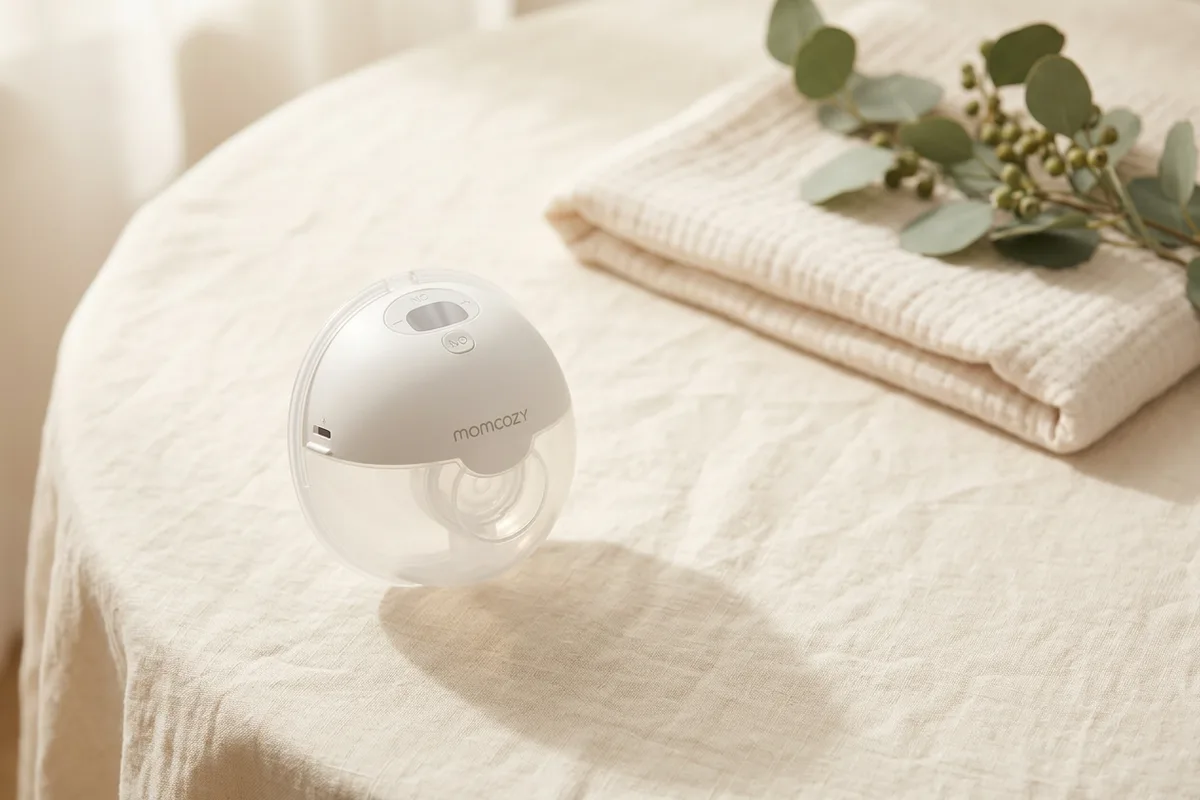
- Quick pick for most parents: a hands-free wearable like the Momcozy M5 Smart covers the everyday case; see my picks below.
How I approached this guide
This is not a lab test — I'm a chemist and a parent, not a pumping clinic, and I won't pretend I bench-tested forty pumps with a vacuum gauge. What I did do is read the FDA and AAP guidance on pump types and fit, and pull each product's specs from the manufacturer's own page rather than a retailer summary. Where a number comes from a brand I call it "stated"; where it comes from a health authority I link it. If I couldn't verify a spec, I left it out.
The 5 types of breast pumps, compared
Almost every pump sold today is one of these five shapes. The FDA's own split is simpler — it divides pumps into manual versus powered (battery or electric), and separately into single-user versus multiple-user — but in 2026 the marketing reality is the five categories below.
| Type | Who it's for | Pros | Cons | Typical price |
|---|---|---|---|---|
| Wearable / hands-free | Parents who pump while working, driving or parenting | Truly hands-free; cordless; quiet; discreet in-bra | Fussier flange fit; battery-limited; often less raw power than a plug-in | ~$120–$300 |
| Portable electric | Out-and-about pumping with a small battery motor and bottles | Strong suction in a small body; rechargeable; flexible | You hold flanges or wear a pumping bra; tubing/parts to manage | ~$100–$250 |
| Traditional double-electric | Daily, high-volume pumping at home or a pump room | Consistent plug-in power; double-sided efficiency; durable | Tethered to an outlet; bulky; not discreet | ~$150–$300 |
| Manual | Occasional pumping, travel, or a no-battery backup | Cheap; silent; nothing to charge; very portable | One side at a time; hand fatigue; slow for volume | ~$20–$50 |
| Hospital-grade / rental | Building supply, premature babies, multi-user medical needs | Strong, durable motors; built for multiple users with own kits | Heavy; usually rented; "hospital-grade" itself isn't a defined standard | Monthly rental |
Wearable / hands-free pumps
A wearable tucks entirely inside your bra — motor, cup and milk collection in one cordless unit — so you can pump while you answer email or push a stroller. The category exploded for a reason: the alternative is sitting still, tethered to a wall, holding flanges. The engineering trade-off is that everything is miniaturized and battery-powered, so a wearable often runs slightly less raw suction than a full-size plug-in, while still cycling between a fast "stimulation/massage" mode (to trigger letdown) and a slower, deeper "expression" mode.
Two things make or break a wearable. First, flange fit — because the cup sits at a fixed angle, the wrong shield size shows up as pain and low output faster than on a traditional pump. Second, battery and suction headroom: check the stated mmHg and sessions-per-charge, because a wearable that dies after four sessions or tops out at gentle suction frustrates a heavy pumper. The Momcozy wearables below state figures like 285 mmHg and up to 8 sessions per charge — numbers that make a wearable a primary pump, not a "sometimes" one.
Portable electric pumps
A portable electric pump is the in-between: a small rechargeable motor (about deck-of-cards size) driving standard flanges and bottles through short tubing. You're not hands-free unless you add a pumping bra, but you get closer to traditional-pump suction in something you can throw in a bag. It's a smart fit if you want strong, adjustable power on the move and don't mind holding the flanges. On hygiene, confirm where milk goes relative to the air path — you want a design where milk stays in the bottle and shield, not one where it can climb the tubing toward the motor (closed vs open, below).
Traditional double-electric pumps
This is the workhorse: a plug-in motor driving two flanges at once. It earns "default" status on mechanics, not marketing — running on wall power, it never rations suction to preserve a battery, and driving both flanges at once means you express both breasts simultaneously, which roughly halves session time versus a single pump. The cost is mobility: you're near an outlet, and it isn't discreet. For maximum repeatable output at home or a workplace lactation room, it remains the most reliable shape — many parents pair one for home with a wearable for the road.
Manual pumps
A manual pump is exactly what it sounds like — the FDA describes operating one by "squeezing a handle or lever to create suction". No motor, no battery, no noise. It's slow and one breast at a time, so it's not your everyday driver if you pump a lot, but it's the cheapest, most reliable backup there is: it can't run out of charge in an airport, and it's great for engorgement or catching letdown on the opposite side. Hand-expression itself costs nothing, and the AAP notes it "is the most convenient first choice with no need for extra equipment" — worth learning even if you own an electric pump.
Hospital-grade & rental pumps
Here's where I want to be a chemist about a word. "Hospital-grade" sounds like a certification. It isn't. The FDA states plainly that the term "hospital-grade pump' is not recognized by the FDA and there is no consistent definition for this term". What's actually meaningful is the single-user vs multiple-user distinction. A true multi-user pump is engineered so that, per the FDA, "breast milk can never touch the working parts of the pump that are shared, and the only part you can safely share is the pump itself" — and each renter buys their own accessory kit. Usually rented from hospitals, lactation consultants or medical-supply stores, these are the right call when establishing or rebuilding supply, exclusively pumping for a premature baby, or pumping under medical guidance. The FDA's rule for consumer pumps built for one person: don't share them.
How to choose: the criteria that actually matter
Once you know the five shapes, the decision comes down to a handful of specs. Here's the engineer's checklist.
Closed vs open system. A hygiene-and-design question, not a marketing one. An open system has no barrier between the milk path and the air pump, so milk vapor (and occasionally milk) can reach tubing and motor parts you can't fully clean. A closed system places a barrier — typically a backflow-protector diaphragm — between your milk and the air path, the same principle the FDA describes for multi-user pumps where milk "can never touch the working parts". For a pump only you use it's mostly about cleaning and peace of mind; for any shared use it's non-negotiable.
Suction, in mmHg. Suction is negative pressure in millimeters of mercury. A bigger number means a stronger maximum pull, but bigger isn't automatically better — comfort and letdown matter more than a record vacuum, and a good pump gives you several levels so you can find the highest setting that still feels okay. The Momcozy models below state maximums in the high-280s to about -300 mmHg, firmly everyday-pump territory.
Cycle / expression modes. Lactation happens in two phases, and good pumps mirror them: a fast, light stimulation (massage) mode to trigger letdown, then a slower, deeper expression mode to draw milk, sometimes a "mixed" mode that alternates. More modes and levels mean more room to dial in what your body responds to.
Flange fit. The single most common reason pumping hurts or underperforms. The FDA advises making sure the "breast-shield opening is the correct size" so you can comfortably center your nipple, and checking before buying whether you can swap in different shield sizes. Many wearables ship with one size (the Momcozy M6 lists a 24 mm flange) and sell inserts separately — confirm your size is available first.
Battery, noise and parts. For a wearable or portable, sessions-per-charge is a real quality-of-life spec; so is noise if you pump on calls (the picks below are rated under ~46–50 dB by Momcozy, roughly library-quiet). And count the parts you'll wash after every session — fewer, dishwasher-safe pieces genuinely change whether you keep using the pump.
Cost — and don't skip insurance. Manuals are $20–$50, wearables and portables roughly $100–$300, hospital-grade units typically rented monthly. Crucially, in the U.S. most health plans must cover a breast pump under the Affordable Care Act — HealthCare.gov spells out the breastfeeding-equipment benefit — so check your coverage (and milk storage and flange sizing, which I cover separately) before paying out of pocket.
Quick top picks for most parents
The short version: for most people the everyday answer in 2026 is a hands-free wearable, because the pump you'll actually use beats the one with a slightly higher spec you have to sit still for. These three Momcozy wearables cover value, budget and premium-slim. The specs are Momcozy's stated figures from its own product pages; ratings are my honest editorial opinion, not customer data, and I'm an independent reviewer here, not affiliated with Momcozy's product team. For the deep dive, see our pick of the best wearable breast pumps.

Momcozy M5 Smart
The all-rounder I'd start most parents on: a true hands-free wearable with app control, Momcozy-stated 285 mmHg suction, 3 modes and 9 levels, ~6 sessions per charge and under 48 dB.
Check price at Momcozy →The M5 Smart is my default pick because it nails the everyday job without much compromise. Momcozy states 285 mmHg of suction across three modes and nine levels, app control so you can adjust without fishing the unit out of your bra, and a battery good for roughly six sessions at under 48 dB — hands-free, quiet and mid-priced for the category. The honest caveat is true of every wearable: get your flange size right, or none of those numbers will feel good.

Momcozy S12 Pro Quick
The endurance budget pick: Momcozy-stated -292 mmHg max suction and the longest battery of these three — up to 8 sessions (240 min) per charge — at under 46 dB and the lowest price.
Check price at Momcozy →If budget and battery are your priorities, the S12 Pro Quick is the pragmatic choice. Momcozy quotes a stout -292 mmHg max suction and the best endurance of this trio — a 1350 mAh battery rated for up to eight sessions (240 minutes) — at the lowest price and quietest stated figure (≤46 dB). It's the wearable for someone who pumps several times a day away from a charger. You give up some flagship extras, but the core job is well covered.

Momcozy Mobile Style M6
The discreet powerhouse: Momcozy-stated -285 to -300 mmHg (the highest ceiling here), 3 modes, 9 levels, a slimmer in-bra profile and a 24 mm flange, under 50 dB.
Check price at Momcozy →The Mobile Style M6 is the pick if discretion and peak power matter most. It carries the highest stated suction ceiling of the three (-285 to -300 mmHg) across three modes and nine levels, and its slimmer cup hides better under a fitted top. It ships with a 24 mm flange (other sizes sold separately), so size-check first. Two honest trade-offs keep it from my outright #1: it's the priciest here, and its battery is rated 5–6 sessions versus the S12 Pro Quick's eight — choose it for the slim fit and suction, not marathon battery life.
Frequently asked questions
A wearable is a cordless, all-in-one unit that sits inside your bra so you can pump hands-free. A traditional pump is a plug-in motor connected by tubing to flanges you hold or strap on. Running on wall power, a traditional double-electric usually delivers the most consistent suction and pumps both breasts at once, while a wearable trades a little power for freedom of movement. Many parents own both — a traditional pump for home, a wearable for on the go.
Not necessarily, because "hospital-grade" isn't a defined standard. The FDA says the term is not recognized by the agency and has no consistent definition, so different companies can mean different things by it. What genuinely matters is whether a pump is designed for a single user or for multiple users. Multi-user pumps (often rented) are built so milk never reaches the shared working parts, and each renter uses their own accessory kit. Choose one for supply issues, a premature baby, or other medical situations — not just because the label sounds clinical.
A closed-system pump puts a physical barrier — usually a backflow-protector diaphragm — between your milk path and the pump's air pump, so milk and milk vapor can't reach the tubing or motor. An open system has no such barrier, so parts you can't fully clean may be exposed to milk. For a pump only you use, a closed system is mainly about easier cleaning and peace of mind; for any pump more than one person uses, keeping milk away from shared parts is essential, as the FDA emphasizes for multi-user pumps.
Flange size is based on your nipple diameter, not your breast or bra size, and getting it right is the biggest factor in comfort and output. The FDA advises making sure the breast-shield opening is the correct size so you can comfortably center your nipple, and checking before you buy whether the pump offers other shield sizes. Many wearables include just one size and sell inserts separately, so if a pump pinches, rubs or leaves you sore, the size is usually the culprit — not the pump. I'll cover measuring in a dedicated flange-sizing guide.
Suction is negative pressure in millimeters of mercury (mmHg), and most everyday electric and wearable pumps top out in the upper-200s to roughly -300 mmHg. A higher maximum gives you headroom, but more important than the peak number is having several adjustable levels so you can use the strongest setting that still feels comfortable — pumping should never hurt. The wearable picks here state maximums in that everyday range; use the levels to dial in your letdown without discomfort.
The CDC's human-milk storage guidance is the standard reference: freshly expressed milk keeps at room temperature (77°F or colder) for up to 4 hours, in the refrigerator for up to 4 days, and in the freezer for about 6 months at best and up to 12 months as acceptable. Don't store milk in the fridge or freezer door, label it with the date, and once warmed, use it within a couple of hours. I'll go deeper in a separate milk-storage guide.
This is the hub of my maternity coverage — if you've settled on the wearable route, see our pick of the best wearable breast pumps for the full head-to-head, or read my hands-on Momcozy breast pump review and the Momcozy vs Elvie vs Willow comparison. For the practical side, I've got companion guides on getting a free breast pump through insurance, breast pump flange sizing, and safe breast milk storage.