

Affiliate disclosure: This post contains affiliate links. If you buy through them, I may earn a small commission — at no extra cost to you. I only recommend products I'd point a friend to, and my editorial opinions are my own, in line with the FTC's endorsement guides (16 CFR 255). Full disclosure here.
I'm a former cosmetic chemist, so when a swimsuit promises it "holds 4 tampons," my first instinct isn't to add it to cart — it's to ask what that number means once the fabric is underwater. And the honest answer, the one most of this category quietly dodges, is the whole reason this page exists: no standalone period swimsuit fully survives a heavy day 1 or 2. Not the $30 one, not the $170 one. If you have menorrhagia, PCOS, endometriosis, or you're swimming through postpartum bleeding, a suit alone is going to disappoint you — and it isn't because you bought the wrong suit.
This guide answers the question the marketing won't: which suit actually has the highest real capacity, why the "pink puddle" running down your legs is physics rather than a defect, and the one layering combo that genuinely gets you through a 30-minute waterpark line on a heavy day. I'll rank the highest-capacity suits honestly — with a real con for every one — and then show you the part that does the heavy lifting: a menstrual disc worn underneath. (This is the heavy-flow deep dive of my full ranked period swimwear guide — start there if you want every flow level, teen and budget pick compared at a glance.) I'm writing as a materials person, not a clinician, so anything about whether your bleeding itself is normal or safe I defer to your doctor and to CDC / FDA guidance, cited below.
Key Takeaways
- No suit alone survives a heavy day 1–2. An absorbent gusset has a finite hydrostatic-saturation ceiling; "holds X tampons" is a still-air, dry-lab claim that fails once the core is full of pool water.
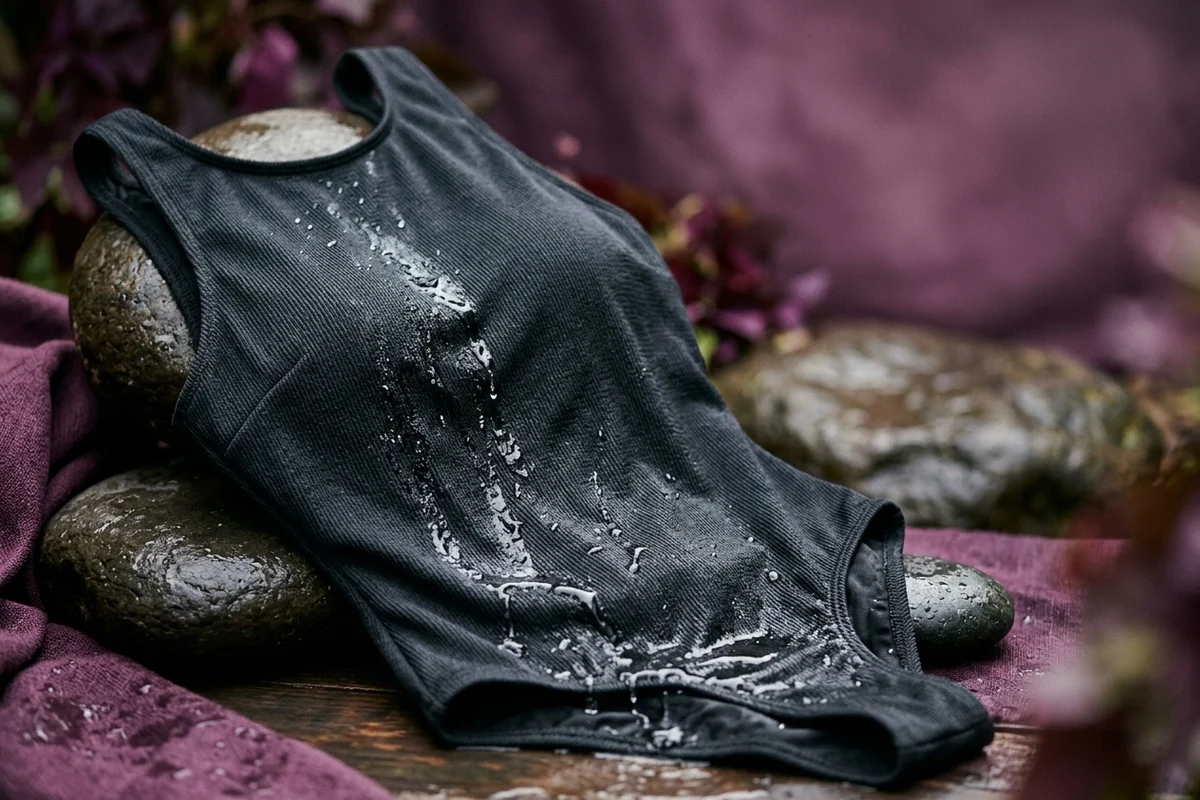
- The "pink puddle" is pool water, not a blood flood. It's faintly tinted water gravity wrings from a saturated gusset as you exit — and it happens to every brand, premium included.
- The fix is the double-up: a menstrual disc as your primary capacity plus a high-capacity suit as backup — the same logic behind the competitive-swimmer "underswimming / drag-suit" trick.
- Highest real capacity: Modibodi's "Super" one-piece — but even its top rating is a dry-lab figure, and the saturated suit feels like a "saggy diaper." Comfiest is WUKA; most honest is Knix (backup-only).
- Beat the squat leak: menstrual discs auto-dump when you squat (sitting on a ride, bending), so stand up and re-seat the disc before you climb out of the water or get in the slide line.
How I evaluated these (a chemist's lens — no lab tests)
To be upfront: I did not run a controlled leak test. There's no panel of swimmers, no "11 of 12 suits survived" statistic, no star-averages scraped from review pages dressed up as my own data — and you should distrust any affiliate roundup that pretends otherwise. What I actually did was read each brand's published gusset construction (layer count, fiber blend, whether the barrier is PUL, TPU or a PU film), take their absorbency claims and then discount them for hydrostatic loss, check OEKO-TEX STANDARD 100 and PFAS posture, verify the live US price from each brand's own page, read the return-policy fine print (the hidden cost of this category), and synthesize the recurring themes real buyers report. Where you see a number labeled "Our score," that's my honest editorial opinion, not a customer average.
I'm a former cosmetic chemist and materials writer — my lane is textiles, laminates and how an absorbent core behaves when it's saturated. I am not an IBCLC, gynecologist, or pediatrician. So every clinical question — whether your heavy bleeding needs a doctor, whether a disc is right for your body, whether swimming on your period is safe — I hand to the authorities: ACOG, the CDC, the FDA, or your own physician. (For the record: medical consensus is that swimming during your period is safe — water doesn't stop it, and there's no menstruation-specific risk. That's the clinical side handled; the rest of this page is materials.)
Why the "pink puddle" happens — and why it's physics, not a defect
This is the fear that sends people to Google at 11pm, so let me explain the mechanism plainly. A period swimsuit's gusset is an absorbent core with a thin waterproof backing — it is not a sealed waterproof bag. On dry land that backing (a PUL or TPU laminate) does its job: it stops your flow seeping outward onto a pool chair. But submerge it, and hydrostatic pressure pushes pool water into the absorbent layer from every direction. The barrier resists outward leakage; it cannot keep surrounding water out of an already-wet core. So the core saturates with water, hits its ceiling, and when you stand up and exit, gravity and the compression of your thighs wring that water back out — faintly blood-tinted, running down your legs. That's the "pink puddle."
Two honest corrections to the panic, in both directions. It is not a blood flood — at typical flow the visible tint is heavily diluted pool water, not menstrual blood pooling at your feet. But it is also not evidence you can buy your way out of: this happens to every brand, the $170 suit included, because it's a property of how absorbent textiles behave underwater, not a quality defect. Spend more and you get a bigger, better-built reservoir — you do not get a suit that seals water out. (This is also why a saturated heavy-flow suit can feel like a "saggy diaper": the core is now carrying water weight, not just blood.) The takeaway isn't "buy the premium suit"; it's "stop asking the suit to be the dam."
The fix: double up with a menstrual disc (and beat the squat leak)
Here's the protocol the rest of the category withholds. On a heavy day, the menstrual disc is your primary capacity and the suit is your backup — visual insurance, not the main event. A disc (or cup) is medical-grade silicone that collects fluid in a cup rather than absorbing it into a textile, so unlike a gusset it doesn't saturate with pool water. Saalt's Regular disc, for example, is rated to hold up to 50 ml — roughly six tampons — and that capacity is real underwater because there's nothing to soak. Pair it under any high-capacity suit and you have a combination that genuinely survives 30 minutes of standing in a waterpark line.
The one warning that trips people up is the squat leak. A disc seats behind your pubic bone, and when you squat or bend deeply — sitting down hard on a ride, crouching, pulling your knees up — that position can auto-dump the disc, releasing what it's collected. So the rule is: stand up and re-seat the disc before you climb out of the water or before you get on a slide. Competitive swimmers have a version of this trick they call "underswimming" or wearing a "drag suit": period bikini bottoms worn under a tight regulation suit, where the compression of the outer suit limits water ingress and keeps the inner layer from shifting (and, conveniently, looks like training drag to a coach). It's the same principle — compression plus a collecting layer beats relying on absorption alone. For the mechanics of how the layers interact, see the period swimwear science and style guide and our explainer on how period swimwear actually works. The insertion and safety details of discs themselves belong with the FDA's menstrual-product guidance and your doctor — I'm here for the fabric and the physics, not the clinical call.
Highest-capacity period swimwear at a glance
| Brand & best suit | Best for (honest axis) | Real capacity (heavy-flow honesty) | Material / barrier | Returns & CS friction | Disc on day 1–2? | Price |
|---|---|---|---|---|---|---|
| Modibodi One Piece Super (#1) | Highest real capacity | Top rating (50 ml dry-lab); bulky when saturated | Polyester gusset; PU leak-proof layer | Opened swim non-returnable; AI-first CS | Yes | $159.99 |
| WUKA Racerback (#2) | Comfiest + chemical trust | Light–medium (~10–15 ml); brand caps it | 3-layer; TPU barrier; bamboo-charcoal inner | UK brand; US return postage on you | Yes | $47 |
| Ruby Love One Piece (#3) | Teen / first-period story | ~3 tampons; light–moderate | Cotton + Dri-tech mesh; no PUL | BBB "F"; store-credit refunds reported | Yes | $169.99 |
| Saalt Disc (the layer) | Primary heavy-flow capacity | Up to 50 ml (~6 tampons); collects, not absorbs | Medical-grade silicone (not a suit) | Standard DTC; internal product | It is the disc | $35 |
| The Period Company "The Swim." (#5) | Budget entry | ~2 tampons; absorbs out of water only | Polyester core; 100% polyester PUL | No refunds; store-credit only | Yes | $30 |
| Knix Classic One Piece (#6) | Seamless looks; BACKUP-ONLY | ~1–3 tampons; light flow only | 3-layer; PU film barrier | Sale final; chatbot-first CS | Yes (it's a layer) | $118 |
| Beautikini Teen One-Piece (Amazon) | Budget / tween transitional | Light–moderate; heavy-flow untested | Layered; waterproof membrane (not named PUL) | Amazon returns; sizing variable | Yes | on Amazon |
Prices verified from each brand's official US page (linked in every section below) as of June 2026; several are on promotion, so the regular price is the stable number. Amazon prices change constantly and are intentionally not listed. Every heavy-flow column says the same thing — pair it with a disc — and that consistency is the point.
1. Modibodi — highest real gusset capacity (our heavy-flow pick)
Modibodi Swimwear One Piece — Super (Black)
The highest credible absorbent capacity in the swim category — the suit I'd pick as the backup layer on a heavy day, paired with a disc.
Check price at Modibodi →If you're going to lean hardest on the suit half of the combo, the Swimwear One Piece in "Super" is the one to reach for. Modibodi rates it at "up to 50 ml / up to 10 tampons" — the top capacity tier I found in swim — over a chlorine-resistant recycled-nylon shell with a polyurethane leak-proof barrier. That's a meaningfully larger reservoir than the light-flow suits below, which is why it's my #1 for a heavy day.
Now the honesty this page is built on. That "50 ml" is a dry-lab absorbency equivalence, not an independently validated underwater figure — Modibodi doesn't publish in-water test data, and as the physics section explained, submersion eats into any rated capacity. The gusset is synthetic polyester, not the merino the brand uses on its underwear line (a common point of confusion — don't expect wool comfort from the swim range). Saturated, it carries the most water weight of any suit here, which is the "saggy diaper" trade-off for the capacity. And the returns are the weak spot: opened or worn swimwear is generally non-returnable, return shipping is buyer-paid, and customer service is AI-first. Even at the top of the table, it is still not enough alone on day 1–2 — wear it over a disc.
- Pros: highest rated capacity in swim; chlorine-resistant recycled-nylon shell; PU leak-proof barrier; OEKO-TEX STANDARD 100 fabric; US 4/XS–14/2XL range.
- Cons: capacity figure is a dry-lab equivalence, not underwater-validated; synthetic polyester gusset (no merino on swim); bulkiest "saggy diaper" feel when saturated; premium price reliant on discounts; opened-swim returns are buyer-paid with AI-first CS.
2. WUKA — comfiest fit + post-Thinx chemical trust (sensitive-skin pick)
WUKA Period Racerback Swimsuit (Black/Blue)
The comfiest fit and cleanest chemical posture — a B-Corp, brand-tested PFAS-free suit — for the buyer who cares more about materials than maximum capacity.
Check price at WUKA →WUKA is the suit I'd hand the buyer who's anxious about chemicals after the Thinx headlines. Its three-layer build pairs a soft top layer with a bamboo-charcoal inner and a TPU waterproof barrier, it's a certified B-Corp made from recycled fabric, and the Swim Shorts page states it's "PFAs-free tested" via an independent lab (HTTS) — a brand-commissioned test, which is more transparency than most. It also tends to win on fit: reviewers consistently call it the comfiest in the category.
This is where the PFAS debate splits, and I'll give you both camps straight. The chemical-anxiety buyer wants exactly this — verifiable testing, recycled materials, no "non-toxic" hand-waving. The compliance-fatigue buyer rolls their eyes: PFAS is ubiquitous in the environment, and a brand-paid test isn't a third-party certification. Both are reasonable. What's verifiable is that WUKA does not carry an OEKO-TEX certification on its swim pages, so I'd lean on the documented PFAS-free testing as the real signal, not the eco-vibes. The honest con on capacity is the dealbreaker for a heavy day: WUKA explicitly caps its swim at light-to-medium (roughly 10–15 ml, ~2–3 tampons) and offers no heavy-flow option. And because it's UK-based, US buyers eat cross-border shipping and return postage. Comfiest, cleanest — but a backup layer, not the dam.
- Pros: comfiest fit in the category; B-Corp, recycled fabric; brand-tested PFAS-free (independent HTTS lab); 3-layer TPU barrier; UV50+ chlorine-resistant; modest $47 price.
- Cons: light-to-medium capacity only — WUKA itself doesn't recommend it for heavy flow; no OEKO-TEX cert (PFAS-free rests on brand-commissioned testing); UK brand means US shipping and return postage fall on you; some styles run low on front coverage.
3. Ruby Love — best teen / first-period swim story (buy with eyes open)
Ruby Love Period Swimwear One Piece (Black Sea)
The best first-period swim story, with a real matching adult-and-teen line — but verify current shipping and returns before you order.
Check price at Ruby Love →Ruby Love owns the teen and first-period swim narrative better than anyone — the same one-piece comes in an adult cut and a matching teen cut, in multiple colorways, with an absorbent cotton + Dri-tech mesh liner and notably no PUL (the brand markets "no swelling in water"). For a kid's first period at the pool, that matched-set story has real emotional value, and it pairs naturally with our first-period letter guide and the beginners' period-underwear guide.
Here's where I have to be a straight shooter, factually and without exaggeration. Ruby Love carries documented fulfillment friction: a Better Business Bureau profile rated "F" (not accredited), driven by unanswered complaints, plus recurring reports of multi-week shipping delays and refunds issued as store credit rather than original payment. I'm not inventing a complaint count or quoting a reviewer — I'm telling you to check the current shipping and return terms before you order, especially at this price. And the price is the other catch: at $169.99 it's the most expensive suit here with no teen discount, and its own pages give inconsistent liner specs (organic cotton on one, two-layer cotton on another), so treat the ~3-tampon capacity as a light-to-moderate marketing figure, not a heavy-day promise. Great story; order with eyes open.
- Pros: the strongest teen / first-period line with matching adult-and-teen suits; cotton-based absorbent liner, no PUL ("no swelling in water"); broad XXS–3XL adult sizing; multiple colorways.
- Cons: priciest suit here ($169.99) with no teen discount; documented fulfillment/CS friction (BBB "F," store-credit refund complaints) — verify current terms before buying; inconsistent liner specs on the brand's own pages; no OEKO-TEX / PFAS certification to cite.
4. Saalt — the menstrual disc that does the real work (the double-up)
Saalt Disc (worn under any suit)
Saalt makes no swimsuit — but a silicone disc that collects rather than absorbs is the layer that actually carries a heavy swim day.
Check price at Saalt →I want to clear up a category myth: Saalt does not make period swimwear. Its catalog is period underwear, cups, discs and bras — zero swim SKUs — and Saalt's own help desk tells customers that its absorbent underwear is for when you're "dry and out of water," recommending a cup or disc instead for water activities. So Saalt earns its place here not as a suit but as the primary capacity in the double-up — the layer that does the real work while any of the suits above plays backup.
The materials reason this works underwater is the whole point of the page. A Saalt Disc is 100% medical-grade silicone that collects fluid in a cup — it doesn't absorb into a textile, so there's nothing to saturate with pool water. The Regular size is rated to hold up to 50 ml (about six regular tampons) for up to 12 hours, and that capacity holds up submerged in a way no gusset can. Saalt is also a Certified B-Corp, and its discs and cups carry independent PFAS testing showing no detectable levels (a stronger claim than the brand makes for its underwear). The honest cons: it's an internal product, so it's not for everyone; there's no OEKO-TEX mark; and the up-front cost is real (amortized over a claimed long lifespan). Insertion technique and whether a disc suits your body are questions for the FDA's guidance and your doctor — but as the heavy-flow capacity engine, this is the piece the suits can't replace.
- Pros: collects rather than absorbs, so capacity holds underwater; up to 50 ml (~6 tampons) for up to 12 hours; medical-grade silicone, B-Corp, lab-tested no-detectable-PFAS; reusable, lowest long-run cost-per-use.
- Cons: not a swimsuit (and Saalt makes none) — it's an internal product, not a garment solution; learning curve to insert and re-seat; watch the squat-leak / auto-dump rule; no OEKO-TEX cert; front-loaded price.
5. The Period Company — the $30 budget swim entry
The Period Company "The Swim." High Waisted
A genuine $30 entry with a real PUL barrier — fine as a low-cost backup over a disc, never a standalone heavy-flow suit.
Check price at The Period Company →If price is the deciding factor, "The Swim." High Waisted at $30 is the honest budget swim option — and unlike some rivals, it actually specs a real waterproof barrier: a recycled-nylon shell, a polyester absorbent layer, and a 100% polyester PUL leak-resistant layer. (One thing to correct: the brand's famous ~$9 price is its underwear, not swim — there's no $9 Period Company swimsuit.)
The brand is refreshingly blunt about the limit, and I'll quote the spirit of it: by its own Swim FAQ, the suit relies on water pressure while you're submerged and only absorbs once you're out of the water — it's not an in-pool absorption product. Capacity is rated at just "2 tampons' worth." So this is a light-flow / backup garment, full stop: layer it over a disc and it's a perfectly good visual-insurance piece for $30. The other catch is the returns policy — no refunds at all, exchanges only on unworn items, store-credit outcomes, international sales final — so size carefully the first time.
- Pros: genuine $30 budget price (HSA/FSA eligible per the brand); real 100% polyester PUL waterproof layer; broad XS–3X sizing; bulk discounts.
- Cons: only ~2 tampons of capacity and, by the brand's own FAQ, absorbs out of the water, not submerged; synthetic core, no merino/cotton; strict no-refund, store-credit-only returns; PFAS testing documented for the underwear, not specifically the swim line.
6. Knix — seamless and pretty, but honestly backup-only
Knix Leakproof Classic One Piece Swimsuit
The prettiest, most seamless suit here — and, by Knix's own ~1–3 tampon rating, a light-flow backup layer, not a day-1 answer.
Check price at Knix →I'm ranking Knix honestly low for heavy flow, and that's deliberate — it's the credibility anchor for this whole page. Knix makes the most seamless, undetectable suit in the category (its whole engineering pitch is a thin, "not a diaper" gusset with a PU-film barrier), and it's genuinely the prettiest. But Knix itself rates the absorbent layer at only ~1–3 tampons and frames it as light-flow / backup-for-heavy-days protection. That is a backup layer, not a heavy-flow suit, and I won't pretend otherwise to chase a sale.
The fine print matters too. Knix does not claim "PFAS-free" — only "no intentional use," acknowledging trace environmental PFAS can't be ruled out — and while a specific cotton underwear bikini is OEKO-TEX certified, I couldn't verify OEKO-TEX on the swim line. Sale items are final, refunds skew to store credit, and CS is chatbot-first and hard to escalate. So: buy Knix for how it looks and for light days, wear it as the backup over a disc on a heavy one, and don't ask its thin gusset to do work it was never built for.
- Pros: the most seamless, flattering suit here; thin PU-film 3-layer gusset that disappears under the suit; very broad XS–XXXXL sizing; strong everyday/light-flow performance.
- Cons: ~1–3 tampon capacity — explicitly backup-only, not a heavy-flow pick; "PFAS-free" not claimed (only "no intentional use"); swim-line OEKO-TEX unverified; sale-final / store-credit returns and chatbot-first CS; premium $118 price for a backup tier.
7. Beautikini — the budget tween / transitional swimsuit (Amazon)
Beautikini Leakproof One-Piece (Teen)
A budget tween/transitional swimsuit for a first period — light-to-moderate only, with heavy-flow performance the brand itself doesn't promise.
Check price on Amazon →For a tween's first swim period on a tight budget, Beautikini's racerback one-piece (its own Amazon listing) is the value entry — a layered training-style suit marketed for girls roughly 11–14, with a quick-dry shell over a terry/modal absorbent stack and a waterproof membrane. It's an honest first-swimsuit. What I'll not do is over-claim it. The brand advertises "4-layer / 3-tampon" leakproof tech, but it also positions the suit for light-to-moderate flow and tells you to pair a tampon or pad on heavy days — so under real hydrostatic load on a heavy period, treat the marketing capacity as untested, not proven.
Two more honest flags. Its certifications ("FDA," OEKO-TEX) are self-asserted on the brand's own pages, and I found no independent certificate number to confirm them — and "FDA certification" for a swimsuit is marketing framing, since the FDA doesn't certify apparel. Reviewers also report variable sizing and thin top padding. As a budget transitional swimsuit for a teen who's just starting out, it's reasonable; as a heavy-flow solution, it isn't one. (For more on how Beautikini's swim design is positioned, see the rise of period swimwear.)
- Pros: lowest-cost entry for a tween/transitional first swimsuit; layered build with a waterproof membrane; teen-specific racerback fit; easy Amazon returns.
- Cons: heavy-flow performance untested — brand itself says pair with a tampon/pad on heavy days; "4-layer / 3-tampon" is a capacity claim, not validated under water; certs are self-asserted with no independent number; reported sizing variability and thin top padding.
A note on Bambody — it's underwear, not swimwear
Bambody (period underwear — dry-land backup only)
Constantly miscategorized: Bambody makes period underwear, not swimwear — solid dry-land backup, but it does not belong in the water.
Visit Bambody →You'll see Bambody recommended in "period swimwear" lists, so let me correct the record: Bambody does not make period swimwear. Its entire catalog is period underwear — bamboo-based briefs, hipsters and bikinis with thin absorbent layers and no waterproof outer layer, which means it isn't designed for submersion at all. There's no Bambody swim ASIN and no swim product to review. Putting it in the pool would just give you a saturated cotton-feel panel with nothing to stop the leak.
Where it's genuinely useful: dry-land backup. Bambody is a cheap, comfortable, PFAS-free (self-claimed) period brief for the changing room, the drive home, or the hours before and after you swim — and as underwear it degrades over time the way all absorbent-textile period products do, so plan to replace pairs roughly once a year. Use it as a backup garment off the water; for the pool itself, one of the real suits above (over a disc) is the answer. The underwear-vs-pads decision, if you're weighing it, is covered in our period underwear vs pads comparison.
Buying guide: reading a gusset spec like a chemist
Strip away the marketing and a heavy-flow swim decision comes down to a handful of materials questions.
Read the gusset geometry, not just the capacity number. The most common real-world leak isn't through the panel — it's around it. Check how far the absorbent gusset extends toward the front and the back; many suits cut it too short, so a shift in the water leaves you exposed exactly where you need coverage. If you're plus-size, pay attention to panel width and the side-leg geometry, because side leaks at the leg opening are a width problem, not an absorbency one. A bigger "tampon" number on a too-short panel still leaks.
Understand the barrier, and its ceiling. The waterproof layer — PUL (polyurethane laminate), TPU, or a PU film — is a backing that resists outward seepage; it is not a sponge and it does not seal pool water out. Every suit hits a hydrostatic-saturation ceiling underwater, which is why the disc, not the suit, is your primary capacity on a heavy day. One practical materials note: laminated waterproof layers don't love sustained high heat, so long hot-tub soaks are hard on a PUL/TPU gusset over time — rinse and fully dry after.
Use OEKO-TEX as your chemical checkpoint — and read it correctly. OEKO-TEX STANDARD 100 is a real third-party label certifying every component was tested against 1,000+ harmful substances for skin-contact safety. It does not guarantee performance, waterproofness, sustainability, or that an item is "organic" — so don't let "non-toxic" copy stand in for it. On the Thinx question that started the chemical panic: that 2023 case was a $5 million settlement in which Thinx denied wrongdoing — a settlement, not a regulatory ban or a finding that the products were unsafe. Worth knowing as fact; not worth fearmongering over. (See the documented settlement.)
Budget for the care and the returns. Period swim needs a full 24–48 hour air-dry between wears or the gusset grows a biofilm that smells; if it does, "strip" it by soaking in a vinegar solution to reset the odor, then air-dry again. And budget for friction: this category is full of buyer-paid return shipping, hygiene "no returns on opened swim," store-credit-only refunds, and AI chatbots — read the returns page before you buy, because a wrong size is often non-returnable. For the full mechanics of how the layers work together, the science and style guide and how period swimwear works go deeper.
Frequently asked questions
Not as a standalone. A suit's absorbent core hits a hydrostatic-saturation ceiling underwater, so on a true day-1 or day-2 heavy flow you need a high-capacity suit plus a menstrual disc, which collects fluid rather than absorbing it. Modibodi's "Super" one-piece has the highest rated suit capacity, but pair it with a disc. Anything about whether your heavy bleeding itself needs evaluation belongs with your doctor, not a swimsuit review.
It's pool water, not a blood flood. Hydrostatic pressure forces pool water into the saturated gusset, and gravity wrings it out — faintly tinted — as you exit. It happens to every brand, premium included, because it's physics, not a defect. To minimize it, use a menstrual disc as your primary capacity, treat the suit as a backup layer, stand still 10–20 seconds before exiting, and step out of the water calmly rather than springing up.
Yes, with the double-up protocol: a menstrual disc as your primary capacity and a high-capacity suit as backup. Watch the squat leak — discs can auto-dump when you squat or bend deeply, like sitting hard on a ride, so stand up and re-seat the disc before you climb out of the water or get on the slide. The suit alone, however expensive, will not carry a heavy waterpark day on its own.
It's a competitive-swimmer layering trick: period bikini bottoms worn underneath a tight regulation suit, where the compression of the outer suit limits water ingress and keeps the inner layer from shifting — and conveniently looks like training drag to a coach. Mechanically it's the same idea as the double-up: a collecting or absorbing inner layer plus compression beats relying on a single absorbent gusset. It's a materials hack, not a medical recommendation.
The Thinx case was a 2023 settlement of up to $5 million in which Thinx denied all wrongdoing — a settlement, not a court finding that the products were unsafe and not a regulatory ban. Some buyers reasonably want certified-clean fabric; others note PFAS is ubiquitous in the environment. The verifiable checkpoint is OEKO-TEX STANDARD 100, which tests for 1,000+ harmful substances. Treat "non-toxic" marketing skeptically and look for OEKO-TEX or documented independent PFAS testing instead.
Rinse cold right after swimming, then air-dry fully for 24–48 hours so a biofilm doesn't develop in the gusset and cause odor. If it already smells, "strip" it by soaking in a diluted white-vinegar solution to reset the gusset, then air-dry again. Expect the absorbent layer to degrade over roughly 12 months of regular use; treat that as a replacement window, and choose OEKO-TEX-certified fabric as your materials-safety signal rather than any unverified lab claim.