
Affiliate disclosure: This post contains affiliate links, including links to Amazon. If you buy through them, I may earn a small commission — at no extra cost to you. I only recommend tools I'd point a friend to, and my editorial opinions and rankings are my own. Full disclosure here.
A straightening brush is the lazy-genius version of a flat iron: you brush your hair like normal and it comes out smoother, with none of the section-by-section clamping. The catch is that "heated brush" covers everything from a $30 travel toy to a $150 salon tool, and the marketing words — ionic, ceramic, steam, nano-titanium — get sprinkled on all of them. What actually matters is boringly consistent: real, adjustable heat, a plate or bristle design that suits your texture, and enough quality control that the thing heats evenly and doesn't snag. This guide ranks the best straightening brushes of 2026 on exactly that — and, as usual, the most expensive one isn't automatically the one I'd hand most people.
Key Takeaways
- Best for most people: the Wavytalk Steamline Pro — a ceramic steam straightening brush with four real heat settings, anti-scald body and auto shut-off, at a fraction of premium pricing. (Buy it on Amazon — more on why below.)
- A brush won't out-straighten a flat iron on poker-straight, glassy results — but for an everyday smooth-and-go it's faster, easier and gentler on your hands. Pick the tool for the result you actually want.
- Heat control is the whole game: the single biggest difference between a good brush and a hair-frying one is adjustable temperature. Cheap brushes that run "one hot setting" are the ones to avoid.
- Match design to texture: dense bristles and high heat power through thick, coarse hair; a smaller, gentler brush suits fine hair and travel. Steam adds moisture that helps frizzy or dry textures smooth at a lower temperature.
How I evaluated these
I didn't straighten forty heads of hair in a lab, and I won't pretend I did. What I did do is read each brush's real specs — bristle and plate design, plate material, temperature control, ionic or steam tech, and safety features — and weigh them against what actually protects hair from heat, then cross-check that against how editors and long-term owners report each one performs. I ranked on four things: (1) how well it smooths your texture without excess heat, (2) heat control (adjustable settings, sensible plate material), (3) design and safety (bristle density, anti-scald body, auto shut-off, dual voltage), and (4) value.
One honest note on the order: this list is ranked by best for the most people at a sensible price, not by raw price or raw performance. The premium Drybar genuinely edges ahead on pure polish — it carries the highest editorial score here, and I say so in its entry — but it costs roughly double the value pick, which is why it doesn't lead.
The best straightening brushes at a glance
| Brush | Best for | Plate / bristles | Heat control | Approx. price |
|---|---|---|---|---|
| Wavytalk Steamline Pro (best for most) | Value, frizzy / coarse hair | Ceramic plates + steam | 4 settings, 320–410°F | Check on Amazon |
| L'ange Smooth It | Precise digital control | Heated brush + digital dial | Digital, up to 450°F | ~$69 |
| Drybar The Brush Crush | A premium finish | Ceramic paddle | Digital, up to 450°F | ~$149 |
| TYMO iONIC Plus | Thick / curly hair | Dense ceramic bristles | 16 settings, 180–450°F | ~$52 |
Prices are approximate street prices at publication and move around constantly — always check the live listing. I've left a hard price off the Amazon pick on purpose, because Amazon's price changes daily; tap through for the current number.
1. Wavytalk Steamline Pro — best for most people

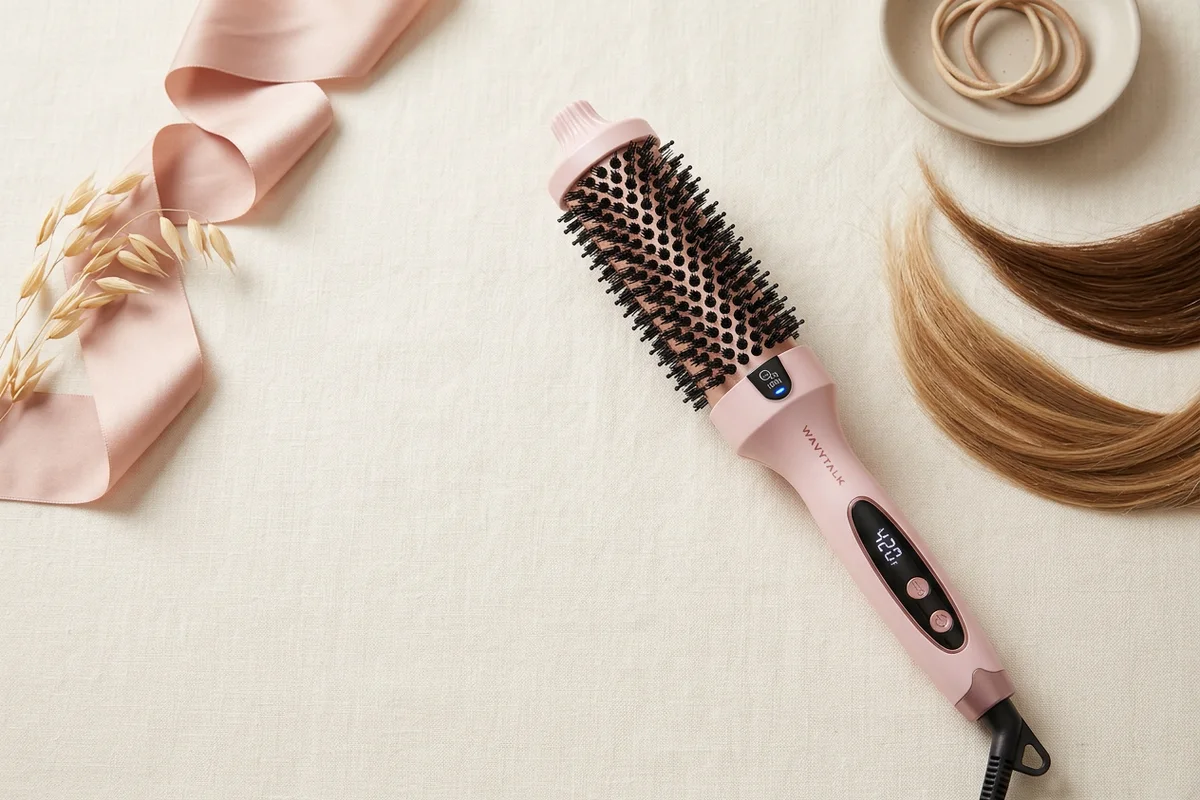
Wavytalk Steamline Pro Steam Straightener Brush
A comfortable brush format with real ceramic plates, four genuine heat settings and added steam to smooth coarse, frizzy hair at a lower temperature — without overpaying. The sweet-spot pick for most textures.
Check price on Amazon →If you want one straightening brush and you don't want to overthink it, this is the one I'd hand a friend. The Steamline Pro gets the two fundamentals right that cheap heated brushes usually miss. First, it has four real temperature settings (320°F, 350°F, 380°F and 410°F), which is the single most important thing for protecting your hair: fine or color-treated hair can stay at 320–350°F while coarse, stubborn hair gets the heat it needs. Second, it uses ceramic-coated plates with triangular teeth (Wavytalk counts 25 micro-plates) so it glides and smooths instead of just dragging hot metal through your hair.
The party trick is the steam. A small 15 mL tank feeds Wavytalk's Hydro-Infusion system, which pushes a fine mist through seven nozzles as you brush. Steam doesn't straighten your hair — heat does — but the added moisture lets coarse, dry or frizzy hair smooth out at a lower effective temperature and look shinier, which is a genuinely useful idea for the textures that need it most. It also runs a 360° anti-scald shell so you can guide the brush with your free hand, a 30-minute auto shut-off, an ionic finish to cut static, and dual voltage (100–240V) for travel. It heats in about 30 seconds.
I'm ranking it first on value, and I'll be honest about the trade-offs. It's a brush, so it will never give you the glassy, poker-straight result a true flat iron (or the wide-paddle Drybar below) can on very resistant hair — a brush is for smooth-and-go, not a mirror finish. The water tank is small, so on long, thick hair you'll refill it mid-style, and steam tools carry a slight learning curve versus a plain hot brush. The plates run hot at the top of the range, so use the lowest setting that actually works on your texture.
One buying note that matters. The Steamline Pro itself reviews well — owners consistently say it straightens fast and leaves hair soft and shiny. The recurring complaint in the low-star reviews isn't the tool; it's the brand's direct customer service, shipping and returns. So buy it on Amazon, not the brand's own site: you get Amazon's return window and support if you ever need them, which takes the one real risk off the table.
- Pros: four real temperature settings; ceramic plates; steam smooths frizzy/coarse hair at lower heat; 360° anti-scald body; 30-minute auto shut-off; ionic; dual voltage; strong value.
- Cons: a brush won't match a flat iron for a glassy finish; small water tank means refills on long hair; steam adds a small learning curve.
2. L'ange Smooth It — best digital control for less
L'ange Smooth It 2-in-1 Straightening Brush
A name-brand heated straightening brush with a true digital temperature dial up to 450°F — the precise control of a premium tool at roughly half the price.
Check price on Amazon →L'ange is a well-known mid-market hair brand, and the Smooth It is its take on the heated straightening brush — with one feature that sets it apart at this price: a true digital temperature dial up to 450°F. Where budget brushes give you three or four fixed buttons, a digital dial lets you land on the exact temperature your hair needs, which is the single most useful thing for protecting fine or color-treated hair from going hotter than necessary. It also carries an auto shut-off and is rated for all hair types.
At around $69 it sits between the budget brushes and the premium Drybar, and the honest pitch is precision-for-price: you get the kind of digital heat control the $149 paddle has for roughly half the money. The trade-offs are fair — it's a step up in price from rock-bottom brushes, there's no steam to buffer the heat (so be disciplined with a heat protectant and a sensible setting), and like any brush it won't match a flat iron for a glassy, poker-straight finish.
- Pros: true digital temperature dial for precise control; up to 450°F for resistant hair; auto shut-off; established brand; premium-style precision at roughly half the premium price.
- Cons: pricier than rock-bottom budget brushes; no steam buffer, so mind the temperature; a brush won't match a flat iron for a mirror finish.
3. Drybar The Brush Crush — best premium finish
Drybar The Brush Crush Heated Straightening Brush
A wide ceramic paddle that hits flat-iron-level heat with digital control and ionic shine — the glassiest finish here, and the highest score in this guide. You pay a premium over the value tools for that last 10%.
Check price at Ulta →If budget isn't the deciding factor, the Brush Crush is the heated brush I'd point you to. It pairs a wide 4.25-inch ceramic paddle with digital temperature control up to 450°F, so it covers more hair per pass and reaches the higher heat that very coarse or thick hair sometimes needs — and the ionic technology genuinely helps seal the cuticle for a shinier, less-frizzy result. It's the established, widely reviewed premium pick, and it shows in the polish of the finish. Little touches like the 60-minute auto shut-off and a salon-length 9-foot cord make it feel like the professional tool it's modeled on.
This is the one brush here that earns the highest editorial score on pure performance — the wide paddle and digital heat get closest to a flat-iron-smooth result of anything in this guide. I rank it third only because it costs roughly double the value picks above, and most people are happier keeping the money; if you straighten often and want the nicest possible finish, it's worth the splurge. One practical note: it tops out hot at 450°F with no steam to buffer, so it's the pick that most rewards a heat protectant and a sensible setting.
- Pros: wide ceramic paddle covers more hair; digital control up to 450°F; ionic shine; the most polished finish here; long salon cord; 60-minute auto shut-off.
- Cons: premium price (roughly 2× the value picks); high top heat with no steam buffer, so be disciplined with temperature; no built-in moisture for very dry hair.
4. TYMO iONIC Plus — best for thick & curly hair
TYMO iONIC Plus Hair Straightening Brush
Extra-dense ceramic bristles plus a wide 16-step heat range grab thick, resistant sections and straighten in fewer passes, with negative ions to cut frizz.
Check price at TYMO →If your hair is thick, coarse or tightly curled, the thing you want from a brush is grip — enough bristle density to actually catch and tension a dense section instead of skating over the top of it. The iONIC Plus is built around that: TYMO packs in 200% denser bristles (134 of them) for what it calls one-pass straightening, and gives you a wide 16-step temperature range from 180°F to 450°F, so you can dial in real heat for resistant hair while still having gentle settings for the rest. It runs negative ions to fight frizz, has anti-scald comb teeth, dual voltage, and an LCD with a memory function. It heats in about 30 seconds.
It's a genuinely strong tool, and it lands a notch below the Drybar mostly on finish-polish and brand-level fit and feel — not on capability for thick hair, where the dense bristles arguably do more. If your main frustration is a brush that "doesn't grab," this is the fix, and at around $52 it's a lot of brush for the money.
- Pros: very dense bristles grip thick/coarse hair; widest heat range here (16 steps, 180–450°F); negative ions; anti-scald teeth; LCD with memory; dual voltage; great value for the capability.
- Cons: high max heat demands restraint on fine hair; finish is a touch below the premium paddle; LCD-and-buttons interface is busier than a simple dial.
How to choose a straightening brush (the science version)
Strip away the marketing and a straightening brush is a hot comb with better heat distribution. Here's what actually matters.
Decide if a brush is even the right tool. A heated brush smooths and de-frizzes faster and more comfortably than a flat iron, and it's gentler on your wrists — but the bristles can't compress a section the way two plates can, so it won't give you the same glass-straight, slept-on-it-and-it-held finish on very resistant hair. If "smooth, soft, frizz-free and quick" is the goal, a brush is perfect; if you want a sharp, poker-straight set, keep a flat iron for the job.
Insist on temperature control — and use the lowest setting that works. This is the lever that protects your hair, and it's the thing the cheapest brushes cut. Heat is what stresses the hair shaft: laboratory work shows that higher styling temperatures progressively degrade the hair's surface and protein structure, and the effect scales with how hot and how often you go. Roughly 320–350°F suits fine, bleached or color-treated hair; you only need to climb toward 400°F+ for coarse, resistant textures. Ionic and steam features help you use less heat; they don't make heat free. The American Academy of Dermatology's guidance on heat styling still applies: lowest effective heat, not every day, always a heat protectant.
Match the brush to your texture. Dense bristles and a high heat ceiling (like the TYMO iONIC Plus) grab and straighten thick, coarse or curly hair in fewer passes. Steam (like the Wavytalk) adds moisture that helps dry, frizzy textures smooth at a lower temperature. A smaller, travel-sized paddle suits fine hair, short styles and packing light but lags on long, dense hair. Buy for the hair you actually have, not the hair in the ad.
Mind the plate material and the safety details. Ceramic and tourmaline-ceramic plates heat evenly and run a touch gentler, which is what you want in a brush you'll drag through your hair. An anti-scald outer shell lets you guide the brush with your free hand without burning your fingers, auto shut-off is worth having, and dual voltage (100–240V) lets the tool travel without frying itself on a 230V outlet abroad. And always brush through dry hair — even on a steam model, the water comes from the tank, not from styling soaking-wet hair.
Frequently asked questions
It depends on the result you want. A straightening brush is faster, easier and gentler on your hands for an everyday smooth-and-go finish, and it de-frizzes well — you just brush like normal. A flat iron compresses each section between two plates, so it gives a sharper, glassier, poker-straight result that holds longer on very resistant hair. Neither is "better" outright: a brush is the better daily driver for soft, frizz-free hair; a flat iron wins for a precise, mirror-straight set.
Any hot tool stresses hair, and a straightening brush is no exception — heat is what degrades the hair shaft, and the damage scales with temperature and frequency. The good news is brushes often let you smooth at a lower effective heat than dry-ironing, and ionic or steam models help further. Minimize damage the same way you would with any hot tool: use a heat protectant, choose the lowest setting that still works (often under 350°F for fine or color-treated hair), don't re-pass the same section repeatedly, and take heat-free days.
No — use it on clean, fully dry hair. Standard heated straightening brushes (including ceramic and steam models) are designed for dry hair; on a steam brush the moisture comes from the built-in water tank, not from wet hair. Dragging a hot brush through soaking or even damp hair can boil the water inside the strand and cause real damage. Blow-dry or air-dry first, detangle, apply a heat protectant, then brush in sections.
Yes, if you pick the right one. Thick, coarse and curly hair needs a brush with dense bristles to actually grip each section and a high enough heat ceiling to straighten resistant hair — that's where a dense-bristle model with a wide temperature range shines. Steam straightening brushes also suit these textures because the added moisture smooths dryness and frizz. A small travel brush will work but be slow on a full head of dense hair, so size up if your hair is thick.
Use the lowest setting that actually smooths your texture. As a rough guide, fine, bleached or color-treated hair does well around 320–350°F, medium hair around 350–390°F, and coarse, resistant or very curly hair may need 400°F or higher. Going hotter than you need just adds heat damage without a better result, which is exactly why adjustable temperature matters so much — and why brushes with only one fixed "hot" setting are the ones to skip.
Yes. A standard electric straightening brush is allowed in carry-on and checked bags by the TSA — just let it cool fully first, and if it's a steam model, empty the water tank before you fly so it doesn't leak. For international trips, check that it's dual voltage (100–240V); plugging a single-voltage 120V tool into a 230V outlet abroad, even with a plug adapter, can destroy it. A compact dual-voltage brush is the easiest travel option.
Want the low-fuss path to smooth, frizz-free hair? The Wavytalk Steamline Pro is the pick I'd hand most people — and if you're weighing a brush against a true plate tool, see my guide to the best steam straighteners next. You can also browse the rest of my hair-tool reviews as the cluster grows.