

Affiliate disclosure: This post contains affiliate links, including links to Amazon. If you buy through them, I may earn a small commission — at no extra cost to you. I only recommend tools I'd point a friend to, and my editorial opinions and rankings are my own. Full disclosure here.
A flat iron is the most over-bought tool in your bathroom. The marketing leans on titanium plates, "negative ions," and 450°F top speeds — and almost none of that is the thing that actually gets you smooth, undamaged hair. The thing that matters is boring: adjustable temperature, so you can use the lowest heat that works on your texture, on a plate material that heats evenly and won't snag. Get that right and a $39 iron can outperform a $200 one. This guide ranks the best flat irons of 2026 on exactly those fundamentals — and, as usual, the most expensive one isn't automatically the winner.
Key Takeaways
- Best for most people: the L'ange Le Ceramique — real ceramic plates, five genuine temperature settings (250–450°F) and dual voltage for around $39. It does most of what a $100 salon iron does. (Buy it on Amazon — more on why below.)
- Temperature control beats plate hype: the single most protective feature is being able to dial the heat down. Fine or color-treated hair should sit at 300–340°F; only coarse, resistant hair needs 400°F+.
- Ceramic vs. titanium is about your texture: ceramic heats gently and evenly (best for fine to normal hair); titanium heats hotter and faster (best for thick, coarse hair you want to get through quickly).
- No flat iron is "damage-free": heat stresses the hair shaft, full stop. Lowest effective heat, a heat protectant, dry hair, and not every day — that's the whole game.
How I evaluated these
I didn't straighten forty heads of hair in a lab, and I won't pretend I did. What I did do is read each iron's real specs — plate material, plate width, temperature control, safety features and voltage — and weigh them against what actually protects hair from heat, then cross-check that against how editors and long-term owners report each one performs. I ranked on four things: (1) heat control (adjustable settings, not a single fixed temperature), (2) plate material and glide (even heating, no snagging), (3) fit for texture (does it suit fine, normal, thick or frizzy hair), and (4) value.
One honest note on the order. This list is ranked by best for the most people at a sensible price, not by raw score. The premium CHI genuinely carries the single highest score on pure finish — I say so in its entry — but it costs roughly 2.5× the value pick and runs at one fixed temperature, which is why it doesn't lead. The two L'ange irons and the Wavytalk do most of that job for a fraction of the money.
The best flat irons at a glance
| Flat iron | Best for | Plates | Heat control | Approx. price |
|---|---|---|---|---|
| L'ange Le Ceramique (best for most) | Value, fine to normal hair | 1" ceramic | 5 settings, 250–450°F | ~$39 (check on Amazon) |
| Wavytalk Steam Sesh | Thick / frizzy hair (steam) | 1.38" nano-titanium | 5 settings, 300–450°F | Check on Amazon |
| L'ange Aplatir | Budget | 1" tourmaline-ceramic | Adjustable dial, to 450°F | ~$30 (check on Amazon) |
| CHI Original | The splurge / best finish | 1" ceramic floating | Single preset 392°F | ~$100 |
Prices are approximate street prices at publication and move around constantly — always check the live listing. I've left a hard price off the Amazon picks on purpose, because Amazon's price changes daily; tap through for the current number.
1. L'ange Le Ceramique — best for most people

L'ange Le Ceramique 1-Pass Flat Iron
Real ceramic plates, five genuine temperature settings and dual voltage for around $39 — it does most of what a $100 salon iron does, for a third of the price. The sweet-spot pick for most hair.
Check price on Amazon →If you want one flat iron and you don't want to overthink it, this is the one I'd hand a friend. The Le Ceramique gets the fundamentals right that decide whether an iron protects your hair or fries it. It uses 1" ceramic plates, which heat evenly and glide rather than snag — the right material for fine to normal hair, which is most of us. More importantly, it has five real temperature settings from 250°F up to 450°F, so you can actually dial the heat down for fine, bleached or color-treated hair instead of being stuck at one blistering preset.
The rounded plate edges let you straighten one day and bend a soft curl the next, and it's dual voltage (110–240V), so it travels without frying itself on a 230V outlet abroad. At around $39 it sits at a fraction of the salon-classic irons, and the spec sheet doesn't give up anything that matters to get there.
I'm ranking it first on value, and I'll be honest about where it gives ground. It's a straightforward analog tool — the five settings are stepped, not a precise digital readout, so if you want to lock in exactly 365°F every time, a digital iron does that and this doesn't. Ceramic also isn't the fastest material on very thick, coarse hair; if that's you, the steam pick below or a titanium iron will get through faster. And like every iron here, it runs hot at the top of its range, so use the lowest setting that actually works on your texture.
One buying note that matters. The recurring complaint in L'ange's low-star reviews tends to be the brand's direct customer service, shipping and returns — not the iron itself. So buy it on Amazon, not the brand's own site: you get Amazon's return window and support if you ever need them, which takes the one real risk off the table.
- Pros: real ceramic plates that glide; five genuine temperature settings (250–450°F); dual voltage; rounded edges for curls too; excellent value at ~$39.
- Cons: stepped analog settings, not a precise digital readout; ceramic is slower than titanium on very thick, coarse hair.
2. Wavytalk Steam Sesh — best for thick, frizzy hair
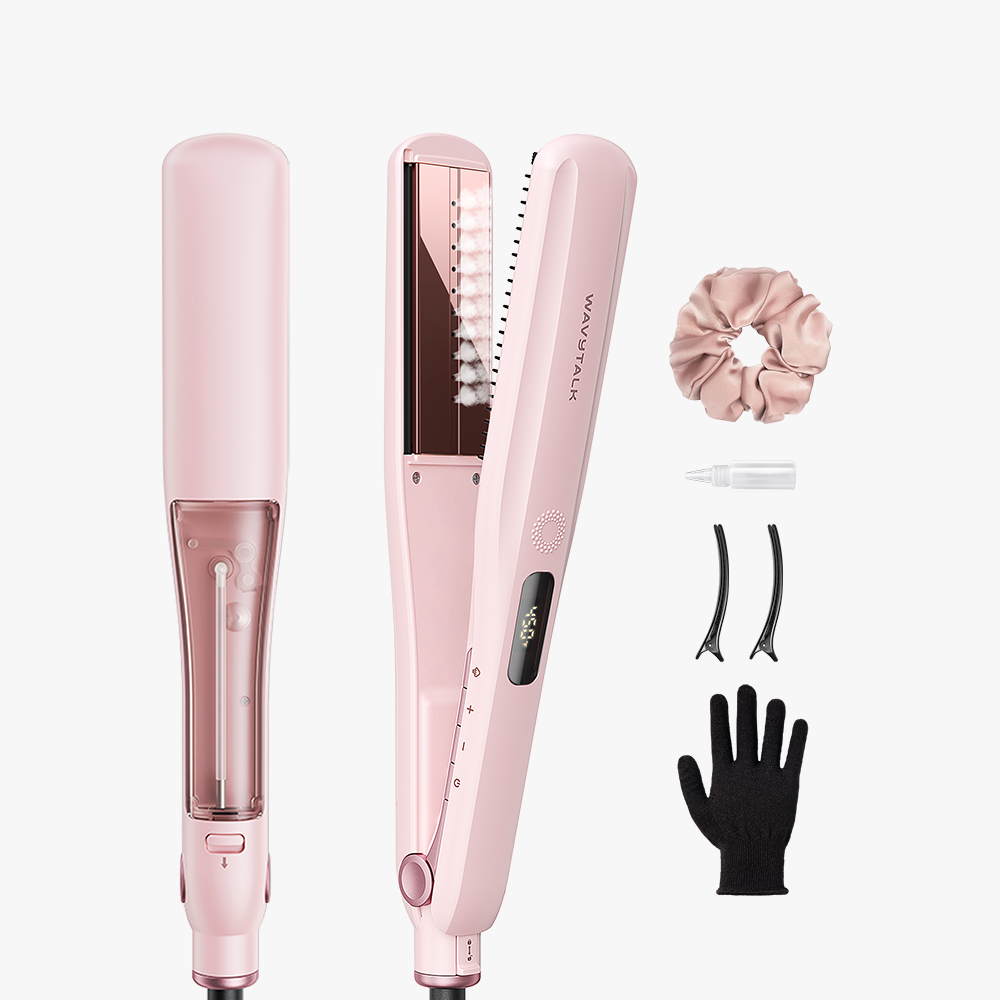
Wavytalk Steam Sesh
Nano-titanium plates plus steam let you smooth thick, coarse or frizzy hair at a lower effective heat. Five real settings and a detachable comb — the texture-tamer of the group.
Check price on Amazon →If your hair is thick, coarse or chronically frizzy, this is the iron I'd steer you to instead of the value pick. The Steam Sesh pairs 1.38" nano-titanium plates — a wider, hotter, faster-heating surface that gets through dense hair in fewer passes — with a small Hydro-Infusion steam tank. The steam isn't magic (more on that below), but it adds moisture as you glide, which genuinely helps coarse or dry hair smooth out at a lower effective temperature than dry ironing would need. It has five real settings (300–450°F), a detachable comb for a softer silk-press finish, a 30-minute auto shut-off, and dual voltage (100–240V). If you want the full breakdown of how steam styling works and how this one stacks up against other steam tools, I went deep in my best steam straighteners guide.
Be honest with yourself about the trade-offs, because steam tools carry a couple the plain irons don't. The water tank is tiny (about 12 mL), so on long, thick hair you'll refill it mid-style. There's a small learning curve versus a basic flat iron — you're managing water, steam and a comb attachment instead of just clamping and gliding. And nano-titanium runs hotter than ceramic at a given setting, which is great for stubborn hair but means fine or fragile hair should stay at the low end of the dial. For thin, healthy hair the ceramic Le Ceramique above is the gentler, better-value choice; this one earns its #2 spot specifically for thick and frizzy textures.
- Pros: wide nano-titanium plates power through thick, coarse hair; steam smooths frizz at a lower effective heat; five real settings; detachable comb; 30-minute auto shut-off; dual voltage.
- Cons: small ~12 mL water tank means frequent refills on long hair; steam tools have a learning curve; titanium runs hot, so fine hair must stay low.
3. L'ange Aplatir — best budget
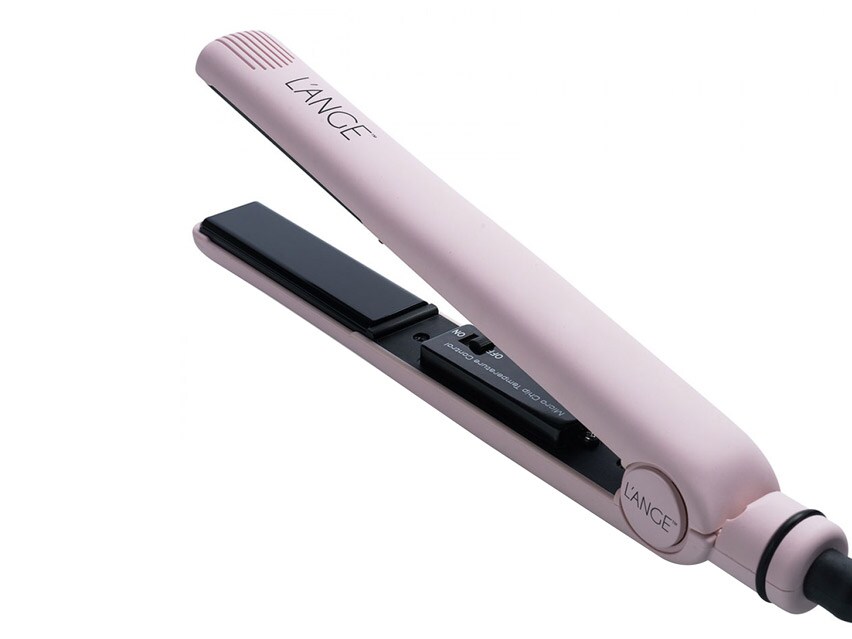
L'ange Aplatir Ceramic Flat Iron
A tourmaline-ceramic iron with an adjustable-heat dial, far-infrared warming and dual voltage for around $30 — the lowest-cost way to get the fundamentals right.
Check price on Amazon →If you want the lowest entry price that still does the fundamentals, the Aplatir is the budget pick. It uses 1" tourmaline-infused ceramic plates (tourmaline is a gentle, even-heating addition that helps cut static), adds far-infrared heat for a smoother warm-through, heats up in under a minute, and — importantly for a budget iron — has an adjustable-temperature dial rather than a single fixed setting, topping out around 450°F. It's dual voltage too. For roughly $30, that's a genuinely sensible spec.
The honest trade-off: it's a dial, not discrete numbered settings, so your temperature control is real but approximate — you're eyeballing the dial rather than selecting an exact step the way you can on the Le Ceramique. It's also the most basic build of the group. But if your budget is firm and you mostly want a competent, gentle ceramic iron that lets you keep the heat sane, the Aplatir covers the bases for the least money — and, like the other Amazon picks, buying it there gets you a reliable return window.
- Pros: lowest price here (~$30); tourmaline-ceramic plates; adjustable heat (not a single fixed temp); far-infrared warming; dual voltage; fast heat-up.
- Cons: heat control is a dial rather than precise numbered settings; the most basic build of the group.
4. CHI Original — the splurge (best finish)
CHI Original 1" Ceramic Hairstyling Iron
The salon classic. Floating ceramic plates deliver the most polished, glassy finish here — and it earns the highest score — but it runs at one fixed 392°F with no adjustability, and it's the priciest pick, so it's the splurge.
Check price at CHI →If budget isn't the deciding factor and you want the nicest finish money can reasonably buy here, the CHI Original is the iron I'd point you to — and I'm giving it the highest score on this list, because credit goes where it's earned. It's the recognized salon classic for a reason: its floating ceramic plates heat evenly and glide beautifully, and the result is the most polished, glassy straight finish of any iron in this guide. Stylists have leaned on it for years, and the build quality shows.
So why is it ranked last? Two honest reasons. First, price: it sits around $100, roughly 2.5× the value picks, and for most people the L'ange Le Ceramique does about 90% of this for a third of the money. Second — and this is the real spec catch — the Original runs at one fixed preset temperature of 392°F, with no way to dial it down. That's a fine, safe-ish middle heat for normal hair, but it means fine, bleached or fragile hair can't drop to a gentler 300–320°F the way it can on the adjustable picks. It earns the top score on finish; it loses the ranking on value and flexibility. That's the splurge, stated plainly.
- Pros: the most polished, glassy finish here; excellent floating ceramic plates; trusted salon-grade build; recognized, well-supported brand.
- Cons: single fixed 392°F with no adjustability (fine/fragile hair can't go lower); roughly 2.5× the price of the value picks.
How to choose a flat iron (the science version)
Strip away the marketing and a flat iron is two heated plates that clamp and glide. Here's what actually matters.
Temperature control is the whole ballgame. This is the single feature that protects your hair, and it's the thing the cheapest (and, ironically, some of the priciest single-preset) irons skip. Heat is what stresses the hair shaft: laboratory work shows that higher styling temperatures progressively degrade the hair's surface and protein structure, and the effect scales with how hot and how often you go. So use the lowest setting that still smooths your texture — roughly 300–340°F for fine, bleached or color-treated hair, up toward 400°F+ only for coarse, resistant hair. An iron you can dial down is safer than one that only knows one temperature.
Ceramic vs. titanium is a texture decision, not a "better/worse" one. Ceramic plates (like the L'ange irons and the CHI) heat gently and evenly and are more forgiving — the right call for fine to normal hair. Titanium (and nano-titanium, like the Wavytalk) heats hotter and faster and transfers heat aggressively, which is exactly what thick, coarse, resistant hair wants for fewer passes — but it's less forgiving on fragile hair. Tourmaline is an additive often baked into ceramic to help cut static. Buy for the hair you actually have.
Curly, coily and Type 4 hair: aim for fewer passes, not more heat. Tightly coiled and Type 4 textures are often the most fragile and the most heat-hungry — a risky combination. The answer isn't a higher temperature; it's fewer passes, so each section sees the hot plates as few times as possible. That favors a fast, evenly-heating plate (nano-titanium like the Wavytalk powers through dense coils in fewer passes, and its steam adds moisture so you can smooth at a lower effective heat), narrower or rounded-edge plates for getting close to the root and shaping a silk-press, and a non-negotiable heat protectant on every section. The discipline that matters most: one confident pass at a slightly higher setting does less cumulative damage than three nervous passes at a lower one.
Plate width should match your hair length and volume. A 1" plate (most of these) is the versatile default — it straightens and can curl, and suits short to medium hair well. A wider plate (the Wavytalk's 1.38") covers more hair per pass, which is faster on long, thick hair but clumsier near the roots and on a fringe. Narrower irons are better for bangs and short layers.
Mind the basics that prevent disasters. Always iron dry hair — clamping a hot tool onto wet or even damp hair can boil the water inside the strand and cause real damage (steam irons are the one exception, and even those supply their own moisture and go on dry hair). Auto shut-off is worth having for peace of mind. And dual voltage (100–240V) lets the iron travel without frying itself abroad. Above all, the American Academy of Dermatology's guidance on heat styling still applies to every iron on this page: lowest effective heat, not every day, always a heat protectant.
Safety, warranty and travel, side by side. The specs that never make the headline but matter once the iron's in your hand — auto shut-off for peace of mind, cord length and swivel for how it handles, travel voltage, and how long the brand actually stands behind it. All four picks are dual voltage; here's the rest, verified against each manufacturer.
| Flat iron | Auto shut-off | Cord | Voltage | Warranty |
|---|---|---|---|---|
| L'ange Le Ceramique | 60 min | 9 ft, 360° swivel | Dual, 110–240V | 1 year (L'ange) |
| Wavytalk Steam Sesh | 30 min | ~79 in (2 m) | Dual, 100–240V | 1 year (+1 free if registered) |
| L'ange Aplatir | Yes | 9 ft, 360° swivel | Dual, 110–240V | 1 year (L'ange) |
| CHI Original | Not stated | 11 ft swivel | Dual | 2 years |
Auto shut-off, cord and warranty are each brand's stated specs at publication. CHI doesn't list an auto shut-off on the Original, so don't count on one; Wavytalk's second year requires registering the product.
And know when to skip the iron entirely. The lowest-damage flat iron is the one you don't reach for on a given day. If your hair is over-processed, breaking, or simply due for a rest, heatless options — air-drying with a smoothing cream, overnight braids or flexi-rods, or a round-brush blowout — get you most of the way with none of the heat. If you want straight-but-gentler as a routine, a true wet-to-dry styler is its own category: Dyson's AirStrait, for instance, dries and straightens with airflow instead of hot plates, but at around $500 it's a different budget tier entirely rather than a pick on this value-focused list. And when frizz is the real enemy, adding moisture beats adding heat — my best steam straighteners guide goes deeper there.
Frequently asked questions
Neither is "better" outright; it depends on your hair. Ceramic plates heat gently and evenly and are more forgiving, which makes them the best choice for fine to normal hair. Titanium (and nano-titanium) heats hotter and faster and transfers heat aggressively, so it powers through thick, coarse or resistant hair in fewer passes — but it's less forgiving on fragile or fine hair. Tourmaline is usually a gentle additive within ceramic plates that helps cut static. Pick ceramic for fine-to-normal hair, titanium for thick or stubborn hair.
Use the lowest temperature that actually smooths your hair. As a rough guide: 300–340°F for fine, bleached or color-treated hair; 350–390°F for normal hair; and 400°F or above only for coarse, thick, resistant hair. Heat damage scales with both temperature and frequency, so creeping up to 450°F "to be safe" is the opposite of safe. This is exactly why an iron with adjustable settings beats one stuck at a single preset.
It depends on your hair. A steam flat iron adds moisture as it works, which helps coarse, frizzy or curly hair smooth out at a lower effective heat and look shinier — a real benefit if dryness and frizz are your issues. A regular dry flat iron is simpler and faster (no water tank to fill) and is perfectly good for hair that's already healthy and not especially frizzy. Steam is the edge for thick, dry or textured hair; for fine, healthy hair a good adjustable dry iron is usually the smarter buy.
Yes — any hot tool stresses the hair shaft, and that stress increases with higher temperatures and more frequent use. No iron, plate material or "ionic" feature makes heat damage-free. You can minimize it: always apply a heat protectant, use the lowest setting that still works (often under 350°F for fine or color-treated hair), take slow single passes instead of repeatedly ironing the same section, only iron fully dry hair, and build in heat-free days.
No — not a regular flat iron. Clamping hot plates onto wet or even damp hair can boil the water inside the strand and cause real, audible "sizzle" damage. Always blow-dry or air-dry first, brush, apply a heat protectant, then style. The one exception is a purpose-built steam straightener, and even those run on a small internal water tank and are still used on dry hair, not soaking hair.
Yes. A standard electric flat iron is allowed in both carry-on and checked bags by the TSA — just let it cool fully and, if it's a steam model, empty the water tank first so it doesn't leak. For international trips, check that it's dual voltage (100–240V); plugging a single-voltage 120V iron into a 230V outlet abroad, even with a plug adapter, can destroy it. All four picks in this guide are dual voltage.
Want the everyday workhorse that beats irons twice its price? The L'ange Le Ceramique is the pick I'd hand most people — and if frizz is your real enemy, the best steam straighteners guide goes deeper on adding moisture to the mix. You can browse the rest of my hair-tool reviews as the cluster grows.